After the success of their first book, Master of Make-Up Effects, Academy Award-winning special effects creator Howard Berger and journalist Marshall Julius have written a second book digging deeper into the love and attachment to monsters, Making Monsters.
While Master of Make-Up Effects focuses on interviews on the history and pioneers of the impact and art of special effects, Making Monsters dives deeper into the monster world with a larger array of interviews of multigenerational monster kids. With an added bonus of even more behind-the-scenes photos and personal photos.
Berger, who’s an icon of special effects, has hundreds of film and television special effects credits to his name, including Day of the Dead (1985) and The Walking Dead (2010-2022). He is a co-founder of the renowned KNB EFX Group.
Julius, who is based in the UK, has extensively written about genre cinema as a journalist, film critic, author, and broadcaster. His passion and knowledge of genre cinema can be seen on every page he writes.
When I asked Berger what it was like writing with Julius, he shared how, “Writing with Marshall is the perfect storm. Marshall is one of the biggest fans of everything fantastic so that’s right up my alley. When we met twenty-two years ago, he nudged me from time to time about writing a book together and when the time was right, we decided to write Masters of Make-Up Effects, and it went very smoothly”.
Berger also added, “When the opportunity arose for a second book, we leaped right into it and created Making Monsters. I could not think of anyone else I’d rather collaborate with on anything than Marshall. It’s a great working relationship as well as a strong brotherly friendship.”
Julius shares with us the monster that made him a monster kid, collaborating with Howard, the creation of the book, and the impact of monsters in his life.
Justina Bonilla: What was the monster that got you into monsters?
Marshall Julius: Oh, definitely King Kong. I get asked that a lot. Howard, he loves the Creature from the Black Lagoon, and he’s a huge Godzilla fan. But for me, it’s King Kong. [He] was always my main monster.
Back in the day, when I was five [or] six, and I had a strict bedtime, as children do, as children are supposed to. They used to have in England, on BBC Two, they used to have double bills of horror movies on Saturday nights. Always just a bit beyond my bedtime, even though I was allowed to stay up a bit later on Saturdays. But it would always be like an old Universal horror, like a black and white thing followed by something a bit more colorful, a bit bloodier, so something Hammer.
But it was the Universal things that got me first. All those kind of vintage things. [When] King Kong was on, I was desperate to see it. And as it happened, although my parents were supportive of my interests and obsessions, they were away for the weekend that King Kong was on. And I said to my brothers, “I really like to stay up and watch King Kong.” And they’re like, “Yeah, I don’t care.”
I stayed up and in a slightly forbidden way, sat with my nose up to the telly watching King Kong. And for me, it was already exciting. I was there watching it. But that movie, it’s so other wildly. I mean, from the moment that it opens, when in New York, and it’s all foggy, it already seems like another universe. It’s practically a hundred years old now.
Even when I was young, it was still an old movie. But I just loved everything about it, the mystery, the adventure. I loved the way it looked. I loved the kind of performances and just the way that it builds up to Skull Island. And then, I mean, just everything about it. Those giant doors, all of this stuff before you even see King Kong. And then, of course, you see King Kong. Then the incredible injustice of knocking him out, of gassing him, and dragging him to another country.
I mean, it’s just absolutely shocking. I was horrified for him. When he was on the stage and getting wound up by all those awful photographers, journalists, and paparazzi, we’re just the worst. And he goes [on a] rampage. I never for a second thought it was his fault. It’s like, it’s that producer. It’s Carl Denham. [He] was the real monster of that movie.
I was so upset and involved and entranced by all. Like, between that and like Star Wars and some other things from when I was younger, I just had no chance. I was just being obsessed with the start.
JB: How did you get into journalism?
MJ: I’m incredibly passionate about films and TV and collectibles and comic books and art, and to a lesser extent video games. When I was growing up, I just knew that I had to either be involved in that world or celebrating that world. And the only thing that I was really good at school was writing. I liked English. I liked writing stories.
It was one of the few things that I enjoyed doing, and I guess I got into film criticism. I used to watch a film critic called Barry Norman a lot on British television. I suppose it just occurred to me when I was about sixteen that this is what I should do, that I can write. I love films. I’m not a super practical person. I have no sense of direction. I am horrified by big forms from banks that have to be filled out. Doing my taxes is like a yearly stress for me. I don’t really like the grown-up adult outside world. But when it comes to movies and writing about them, then I feel I can sound reasonably intelligent there. I feel like I’m on a safe ground.
So, for me, all the fantasy worlds that I lose myself in are like I’m much more comfortable there. I don’t know, maybe a lot of people feel the same way. So, I always sort of retreated into those things. It occurred to me when I was still pretty young that really the only thing I could do was be a film journalist, and I didn’t have a plan B. I thought maybe I would end up, you know, working in a video store or a homeless begging for money. Because it’s like, I don’t know if I there’s anything else that I could do.
Fortunately, when I finished doing my A-Level [at] eighteen, and I did a I did a college magazine as a project through my media studies, which turned out really well. I did it with a friend of mine, Robert Sims. And then I just thought, “Okay, well, I’m just going to try and get a job.”
Now, naivety sometimes goes a long way. So, I just wrote to every London based magazine and newspaper. This is pre-internet, so there were fewer choices. But I guess I wrote about forty or fifty outlets, like everyone that I could get the address of and just said, “ I’m a huge fan of your publication, and I’ve been reading it for years.” Which was just a huge lie. “And I would love if you could consider me for a role.”
And you know, I [was] just completely deranged really, but I sent it out to everybody. And this magazine called What’s on in London magazine, which went back to the Second World War. You don’t really have them anymore. Back in the day before the internet, if you wanted to know what was showing at the cinema and what time, or what was on at the theater, or what was showing at different galleries, or, you know any of that stuff, you had to get listings magazine that would tell you everything day by day. And so, What’s on in London which was that they got back to me, and they said, “Come for an interview. Let’s chat.”
And my editor there, David Bristow, he didn’t like people who were over-educated. He had a bit of a chip on his shoulder, and so he liked that I hadn’t gone to university yet, and he just offered me a job on the spot.
I mean, it didn’t help that they needed somebody to cover not their film section, but their classical music section. So, I like classical music. I pretend to know too much. I don’t feel like I’m on safe ground when I’m writing about it like I would with films, but he offered me that and to be their opera critic at 18. And I’m like, “Yeah, I can do that.”
JB: How did you pull off being the opera critic?
I remember there were two big main opera places in London. There’s the English National Opera which puts everything into English when they sing. But obviously the way that opera is sung, even if it’s in English, you can’t understand a bloody word they say. And there was the Royal Opera House, which was original language operas. And they’re both very opulent, very fancy places.
And so, I would turn up, like once every couple of weeks for a new show. I like opera, but I get so bored [for] three hours. It’s just like, “Oh my God, these old fat guys standing on the stage pretending to be eighteen-year-old super lovers. Like you’ve got a good voice mate, but this is a visual thing.” And they don’t move around. I didn’t really like the way the operas were staged or anything. So, I thought, “I’m not qualified to talk about this.”
I used to [during] the intervals, go walk around when everyone was having a drink and stuff, and everyone was trying to impress each other with their knowledge. I would listen to people talking about the opera. I would write it down, and I would pass all that shit off as my own opinions. And that’s how I managed to keep my job for the first year or so, plus doing all the listings and stuff.
I made sure that I got my hooks into the film section. I introduced a DVD review. Actually, it was VHS. It was a video review section then, because it was like 1990 by the time I got that. And then, after about a year or two, they were like, “You know Marshall, for an opera critic you know a lot about movies.” And then they started shifting me over and letting me do what was more natural to me.
Then I became the film editor. I quit a few times over the years wanting to travel, wanting to write my first book, which is about action movies. But I kind of kept going back there. It took quitting three times for me to finally get out in the world and to be a freelancer, and that was a struggle. But, you know, I always somehow managed to survive as a journalist somehow. Sometimes hanging on by my fingernails, but I always somehow managed to just about hold on and to keep at it. To stay writing about the world I love, and to go off and have adventures, and to somehow get paid to go and see movies.
JB: How did you and Howard connect?
Well, I was writing for The Sunday Express freelance. I was offered an interview with Howard to promote The Chronicles of Narnia: The Lion, the Witch, and the Wardrobe, the one that he’d won the Oscar for as the creature maker extraordinaire. And Howard had said to Disney, when they asked him [to promote it], “I’m happy to go over to London to do some promotions, but instead of me just talking to everybody, which is a bit boring, why don’t I take a bunch of prosthetics down and I can make up the journalists in different monster makeups while we’re doing it? Because it’ll just be more visual.” He has always got an angle.
I went to interview him [at] this venue they’d rent out on the south bank. They’re like, “Okay, this Howard Berger, he’s going to make you up as Mr. Tumnus.” So, I take my glasses off. I’m completely blind when I haven’t got my glasses on. And I was just chatting with this great, fuzzy guy in front of me.
Most times when you interview somebody, there’s a little bit of distance. You’re here to interview them. And off, it’s friendly, but it’s transactional. When it’s done, it’s done, you go away. They’ve got their publicity, you’ve got your story, which is how it should be. But every now and then, you just kind of hit it off with somebody, very rarely. But you think, “Well, actually, we could be like, friends?”
The thing about makeup effects artists is that they all grew up as just mega nerds, as loner mega nerds, like me. They weren’t like the cool kids. They weren’t like, I don’t know, playing sports and all that sort of bullshit. They were like in their bedrooms, making masks, inhaling glue, and not deliberately. They were just like watching horror films and reading monsters and playing with Aurora model kits and figuring out how to build their own masks. If they were lucky enough to have a few friends, like minded friends, that was just everything and their whole obsession.
So, for me, I felt like Howard and I grew up loving all the same things, and clearly, from us just chatting a few minutes, he was like, “Well, we should just be friends.”
But you know, you can’t say things like that, because then you just sound like a mad stalker. So, I got his address so I could send him a copy of the newspaper. And then I would email him a few times, because thank God, email [had] come in. So, I would email him occasionally. And for the first few years that I knew him, obviously, I sent him a copy of the paper, and we stayed in touch. I interviewed him a few times for different outlets, and then we just started talking. It just sort of happened, sort of naturally.
JB: What led to the first book?
We’re just chatting one time and we’re talking about our book collections and loving movie books and how much we cherish our favorite movie books in the same way that we cherish our favorite movies.
And he was talking about a book called Making a Monster, which, I don’t know if you’ve seen that, but you should check that out by Al Taylor and Sue Roy. It’s out of print, but there’s always copies of it on eBay. So, Howard loved this book when he was younger, and he had it. Because he grew up in Hollywood, he used to carry it in his backpack permanently, in case he went to a convention, or in case he bumped into someone who was featured in the book. He literally would have a pen and this book, and he got it signed over the years by all these people.
Then Howard was telling me how his favorite part of the job is hanging out with his friends, sharing stories. And we were like, sort of collectively [thinking], we should totally do a book together. This would be great. And we could do exactly that. We could just be a book of stories. And he’s like, “Yeah, I’m in. Let’s do it!” And then I go off and tell my wife, “I’m writing a book with Howard!” And then, I spoke to him in a few weeks, and it’s like, “Well, I can’t do it right now, because I’m working on this project, or I’m working on that project.” Fair enough. He was absolutely riding high and having this amazing Oscar-winning career.
So, every six months, I would say to him, “So how about now?” And he’d be like, “Oh, I’d love to Marshall, but I’m making these twelve films.” I’m paraphrasing here. “I’m doing this thing with…,” Or “I’m doing, you know, Hitchcock with Tony.” And you know, he never acted like it was a bother for him, for me to keep pestering him.
So, I pestered him for a decade. I just never stopped. Maybe to the outside world it seemed like I was just some crazy fucking stalker. For some reason, Howard could have either just said, “Look, just stop contacting me”, or he could just give in. And fortunately for me, he never called the police on me.
And then the pandemic happened, which was, of course, a worldwide disaster. I messaged him, and I said, “Howard, I bet you’re not busy now.” And he said, “That’s true.” I said, “I bet the people that we could talk to for the book aren’t busy either.” He said, “That’s also true.” I said, “Let’s have a call.” So, we’re having a conversation and I said, “So let’s do it now.” I literally had nothing else. I’d lost all my freelance gigs and stuff.
Then Howard said, “Yeah, okay, now’s good time. Let’s do it.” Within twenty minutes of the conversation ending, he had sent me a list of people that we could reach out to for the first round of interviews, and I had sent him a list of chapter titles that I thought we could break it up at. Two years later, we had our Masters of Makeup Effects.
We only sort of scratched the surface of Howard’s connections and his friends. You know, he’s built up a lot of goodwill over the years. And he wanted to do something to celebrate his friends and their stories and their art.
JB: When did you two want to make a second book?
When we finished the first one, and we’re thinking about what to do next, he didn’t want to just do a part two. And neither did I.
JB: I read that you two wrote this book during the strikes.
Yeah, that’s why Howard thinks that I’m now going out and causing disasters, so that I can write another book, like all the strikes. And so, you know, Hollywood was kind of going [up] in flames, practically, and, and I’m like, “Well, now is a good time for us to do another book.”
JB: Basically, you’re sitting there roasting a hot dog on a stick, thinking, “Whelp, while there’s a fire.”
You gotta find the silver lining, haven’t you? So now I say that if we’re going to do another one, I’m just I’m not sure what the disaster is going to be. Because it can’t be a world ending disaster like a zombie apocalypse. It just has to be something that shuts everyone down. So, I think they think I’m going to go off and try and start some new disease or something. I don’t know. We’ll just have to wait and see. But definitely, if the world is rocked by some terrible event, the first thing I’ll do will be to reach out to Howard and say, “Okay, it’s time to do number three.”
JB: How did you come up with the monster theme?
[Howard] said, “If you think of something that’s like in the same sort of format, but different, then, let’s do it”. So I went for a walk, and I came back and I called him. I said, “How about just monsters?” And he was like, “I’m in!” And that was it that.
Whereas the first book focused entirely on makeup effects, and people who have makeup effects applied to them, this book is about monsters from every perspective. Obviously, we’re talking to Howard, and it’s through Howard, a lot of his contacts are in the makeup effects industry.
But it also meant that we could include visual effects. It meant that we could talk about Ray Harryhausen and stop motion effects. It also meant that we could speak to composers and directors and writers, not about the effects, but what it takes to write a monster, what it takes to score for a monster, and all the different aspects of that. So, it felt definitely in the same world. Definitely a sister companion to masters of makeup effects, but with its own personality.
JB: What made you two decide on the format of this book?
[I] wanted to do something in the same format, because I really love the kind of conversational format, jumping from quote to quote. Not having to lay out the full story, which can get a bit dry.
Everybody’s read endless making ofs where it’s just trying to the good bit. That’s what this book is. This is just the two or three really good stories that everybody has. And although some people definitely have more than two or three good stories, I just wanted to have all the cream and to just be brutal about everything else.
We did a hundred sixty hours or something of interviews for the second book. Even though it’s thousands and thousands of words, it still only kind of covers a small portion of that. But it’s the best bit. It’s the bit that made me smile. The bit that made me think. The bit that made me feel something, you know.
JB: How did you get so many never before seen and personal photos?
I mean, we didn’t want it to be just a lot of photo library stuff that everyone has seen. The same pictures, you know? Instead, we were like, “Oh, let’s just ask everyone for their own pictures. More private stuff. And make it more intimate. Make it more unseen. And obviously, there were a few times when we wanted to have the library picture of the finished creature or whatever. Or we wanted a few stills or posters.
JB: There are so many people that you’ve interviewed for Making Monsters. Was there ever a point where you were interviewing someone and you thought, “I can’t believe I’m interviewing this person?”
Almost every single one that we did. A lot of the makeup artists are amazing artists, but they’re not necessarily names that you’ve grown up with. They’re people who I learned about growing up and reading Fangoria and Starlog and Starburst and Famous Monsters and all of those other things. And some of them I hadn’t heard of before.
But yeah, for this new one, I couldn’t believe it when I was interviewing John Carpenter. I couldn’t believe it when we were sitting and talking to Joe Dante.
For the last book, we interviewed John Landis. We interviewed Tom Savini and Rick Baker. We interviewed Tom Savini and Rick Baker again, for the new book, because, of course, why the hell wouldn’t we?
We interviewed Larry Karaszewski, who’s a fantastic guy and such a great writer. He co-wrote with Scott Alexander, like Ed Wood. I interviewed lots of great people, and I just felt tremendously privileged to be able to do that.
JB: That’s amazing! As a fan, what was it like to interview so many talented people?
Honestly, most of them are just fans themselves. They’ve all had experiences where they’ve met people and lost their shit.
They all get excited about people, and even Howard, as cool as he is. When we interviewed Rick Baker, who he’s known since he was a child, he spent a year calling Rick Baker’s house. So, he found out his name, Richard A Baker in the phone book, and he called for a year every day asking to speak to him when he was a kid. And eventually his wife said, “Look, he’s in the shop.” She arranged it, and he went to meet him.
He did the same with Stan Winston. And Stan Winston said that “You can keep coming here, so long as you don’t get lower than a B in school. If you drop in there, you can’t come back.” So, Howard made sure that he was a straight A [student]. But Howard is different around Rick Baker.
Howard is just a little bit different with Rick Baker than he is with everyone else, because he still absolutely reveres him and just regards him as like an almost supernaturally gifted and important person in his life. Which is fair. I mean, it’s Rick Baker. The guys is [the] Mozart of makeup. They’re all fans. They were getting excited about each other.
I mean, Damien Leone, when we interviewed him, he was fanning out over Howard, about all the horror films that he’s worked on and stuff. You know, people like Damian, he’s hit it now with the third Terrifier film, he is like, in great demand and he came to both of our signings.
I mean how cool is that Jason Reitman who’s like a proper, grown-up director. He’s not just a genre director. I mean, this guy did Juno. This the guy that did thank You for Smoking and Up in the Air and as well as all the great Ghostbusters stuff. But, you know, he was just happy to be there.
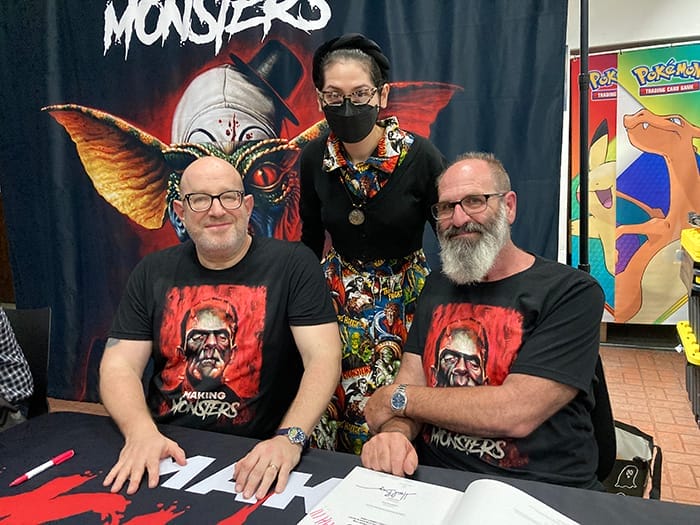
JB: You’ve had two signings with Dark Delicacies for these books. What was it like doing both of those signings? I met you and Howard at the second signing.
The first signing that we ever did for the first book that was at Dark Delicacies when Dark Delicacies were still open. And that was like one of the best days of my life, honestly. After spending, you know, two years working on this book and then extra time plugging it, it like became my whole life and. And also, because we’ve done it all on the computer, all the interviews, everything without barely leaving the room.
So suddenly, and because I’d gotten so close with Howard, but still not actually hung out with him. We still not actually sat and watched a movie together, you know. Doing the things that you’re supposed to do with your friends.
We did this signing and it was such a lovely atmosphere. It was like everybody was signing their books, each other’s books, like it was [a] school yearbook, because they’re all working [at] different places. They don’t get to hang out on that sort of level. So it was just the best atmosphere and everybody was so happy to be there, you know, from the people getting the books and queuing up to the people doing the signing. People felt so seen and included and celebrated. There was nobody there that wasn’t thrilled to be there.
And I felt like all those years of chasing Howard and all the effort and doing all of that, it all like paid off in that one sort of afternoon. I had to be present, you know. I had to pinch myself and say, “Don’t forget this. This is the most amazing thing.”
You know, as a journalist, as a film fan, I always felt like I had my nose pressed up against the glass, outside looking in at the cool kids, and desperately wanting to be included. And maybe it’s not very cool to admit that, but it’s like I always felt like an outsider and just always wanted to, you know, kind of be a part of something.
I kind of made this thing with Howard that everybody wanted to be a part of themselves. So, it just felt like this massive sort of culmination of my life, really, without making too big a deal of it. For me, it was absolutely huge. And I just loved it. I had so much fun on the signing for the first book there, I thought, “Well, we’re going to have to do another book, so I can come back and do it all over again.”
The second Dark Delicacies signing, the one that you were at, that ultimately came about in part because I loved the first signing so much. It was like this party has to keep going. I mean, yes, we had enough, but for me, it was an absolute dream just seeing all those people together. Having again, everybody coming, and being happy to be there. It was so fun and exciting. And just I loved it. I mean, that is happiness for me. At least I thought that was the happiest I could be, until Halloween night, when I met John Carpenter again.
JB: How did that happen?
We went to the John Carpenter concert. [Howard and I] we’re chatting a bit, and then Howard’s like getting a bit impatient of queuing. So, he goes up and talks to someone, the guy in the front. And they’re like, “Oh, Howard, you should come in.” Sandy King, John Carpenter’s wife, said to come up and hang out with them in the VIP area.
We go up and it’s overlooking the stage, and to the right, there’s a screen. To the left there’s the audience, and they’re beginning to file in. And there’s Sandy. She’s very welcoming and offers drinks. And then this other woman starts chatting with me. She was from England, so it was nice. We had a chat for a few minutes. And then she introduces herself. She’s Cindy Franco, and her husband, Larry Franco, who is of course, the producer of almost all of the great John Carpenter films. And he also produced, like, a ton of Tim Burton movies.
So, I’m, like, freaking out as usual. It’s just in a whole lifetime of freaking out, but this was like a few hours after the Robert Englund thing. And you know, that was, that was almost too much for me. It’s almost like more than I can handle. So, I said to him, “Thank you so much for making these movies. It’s like, I can’t tell you what they mean to me.” And he’s like, “Well, you know, it’s really as John Carpenter did it.” And I’m like, “Okay, but you made it possible for him to make those films. And that’s not nothing.”
Then we started talking about how he managed to do the kind of fake CG effects in Escape from New York. Then he asked me what my favorite John Carpenter film is. And I thought, “Okay, better definitely not say one of the few that he didn’t produce.” But I mean, to be honest, my favorite John Carpenter film is Prince of Darkness and I told him that. He said, “No one’s ever said Prince of Darkness before.” And then I, of course, explained to him why I love that film so much. So we had a very nice chat.
Then the concert starts. I got Larry Franco on one side, and I got Howard on the other. Everyone’s just losing their shit and just head banging and doing the sign of the devil. John Carpenter [was] taking a break in between when he’s not playing and he’s doing like devil horns and pointing them at the fans. And it’s like everyone’s getting super excited. And I just lost my shit. I screamed at the top of my voice, “I love you, John Carpenter!”
Then at the end of [the concert], they’re like, “Oh yeah, let’s go back and hang out with John.” And it’s like you don’t have good security, because you shouldn’t drag people like me back to meet John. I said, “Let me take a picture of you all together?” Then, “Can I get a picture?” I sit down, and they take a picture of me doing the devil horns, and John Carpenter laughs, and he does the finger, which is very on brand for him. But, you know, it’s like, there are very few pictures of John Carpenter smiling, let alone laughing, you know?
JB: What was it to attend the Robert Englund Hollywood Walk of Fame Ceremony?
We got there about an hour before the ceremony, and there’s all these screaming, you know, Freddy Krueger fans, Robert England fans. And they’re all wearing the stripy sweaters, and masks. Oh my God, they must have been hot. But that’s the fandom, isn’t it? It’s like, you’re a bit hot. Screw it.
It’s but there I am, and some of our contributors from the first book, you know, Kevin Yeager, who’s a legend, and Jeff Yaeger, his brother, an amazing artist as well. They were there with their wives. And Kevin Yeager’s wife is Catherine Hicks, who was in Child’s Play, and of course, she was also in Star Trek IV. I’m a huge Star Trek fan, and so I start smiling ear to ear. And I’m like, “Okay, I’m just gonna talk to Catherine.” And we talked for like an hour about and she ends up sitting next to me during the thing.
Robert Patrick [was] there. I had no idea he was going to be there. And I’m like, “Hi, I’m Marshall Julius. I love you in Terminator 2.” I said, “I really enjoyed you in Peacemaker and True Blood and the million other things you do.” And he’s like, “What’s your name?” I said, “Marshall Julius.” And he’s like, “Maracle Julia?” He got it wrong like three times and then I realized he was just fucking with me. And I said, “Can I just have a picture please? And he’s like, “Yeah, of course.” He gets up, we do a picture, and I was like that the whole time.
I was getting so overexcited that a few times I just actually clap like a five-year-old. Howard asked, “Why are you doing?” I’m like, “I’m just excited.” He said, “What are you like five-years-old?” On a good day, I’m five years old.
JB: How would you describe working together with Howard on this book?
It was an incredible labor of love, and I could never have done it without him. And he could never have done it without me. I mean, I feel like we just completely complimented each other and between. It was such an ambitious project. I don’t know if it looks it, but it was such an ambitious project to involve that many people.
But for the most part, that’s because Howard’s built up such an amazing reputation over the years, and people just love him and wanted to help. And beyond that, [they] wanted to be a part of the project. It felt like it was a legacy for them and the industry.
JB: After all these years and two books later, how would you describe your friendship with Howard?
We met when I interviewed him for The Lion, the Witch and the Wardrobe coming out on DVD. Then I chased him for 10 years to write the book. We spent two years writing the [first] book. But our entire friendship, we were like pen pals, but Zoom. The first time that I was actually physically in the same place as him, when we actually saw each other for real, was after we’d written the book, when I went out to LA for when we did the first round of signings for Masters of Makeup Effects.
So, I mean, there’s practically 15 years in between meeting him and going out to stay at his place for a week, while we went and had all these adventures. He became my best friend while we were working on Masters of Makeup Effects. He was the person I spoke [to] every day for like two hours. Plus, we were very invested in the book. He was the person who, if I ate something interesting, I would send him a picture of it. And we just work very closely together. He’s never shrugged me off ever.
JB: What are you hoping that readers will take away from this book?
I just hope that people enjoy it, and that the passion and the fun of it is imparted to them.
That maybe they’re inspired to do whatever it is that brings them joy. If it’s filmmaking or whatever, because I think that it’s sort of inspirational. Not solely for people who want to get into the film business. I think that if you read the sort of origin stories of people you admire, and you realize that it’s possible.
And maybe, I just wanted to demystify it. Make it seem more achievable, less mysterious, you know. I think that’s what I would like. I’d just for people to see this sort of the human side. The kind of side that maybe you don’t see.
Last: Author’s note: I asked both Marshall and Howard this question at different times:
Who do you think would win a fight? Godzilla or King Kong?
Howard Berger: That’s a tough one, and a question I have pondered for years. Yes, a grown man thinks about this… I am going to say Godzilla and my reasons are ultimately he’s bigger and stronger, plus he has that radioactive breath, and that’s a difficult thing to beat. Though Kong is a primate and may be smarter, Godzilla has the upper hand.
Julius: Oh, King Kong. That’s not difficult. Howard always says, Godzilla. Obviously, you know, we’ve we talked about this at great length, and Howard’s like, “Radioactive breath”. And, yeah, but opposable thumbs.
And he’s like, “Oh, but Godzilla is much bigger”. Well, it depends which Godzilla you’re looking at. And I think if you’re gonna actually pitch Godzilla against King Kong, you have to at least take away the size advantage. So, you have to put them more in the cut.
I don’t really like the American kind of Kong versus Godzilla movies, particularly. The first one was okay, but, I mean, they’re pretty dumb. I mean, it was such bullshit. But compare that to Godzilla Minus One, which is a fucking work of genius and just incredible art.
But I think if you say they’re the same size, and Godzilla has the radioactive breath and the tiny arms, which are basically good for nothing except looking silly. This is how I [was] on the plane on the way over. I was sitting against the wall, and I couldn’t move my arm to eat. And I thought this is how Godzilla would eat if he was on a plane. How do you even manage? He’s got those ridiculous hands.
But Kong, he’s a lot more mobile. He can jump around. He can punch you. He can actually run behind you and strangle you and stuff. So, I think that King Kong is just going to be more agile.
Yes, if Godzilla manages to land a radioactive beam, then, you know, obviously Kong is just going to be dead in five seconds. But you know, everybody has those sorts of [conversations]. That’s what monster kids talk about.