Continuing our three part Screaming Room Film Festival filmmaker interviews series, part two, Saturday, highlights films from animated terror, to Halloween treats, to moments and monsters that made us go WTF.
Among the many fear-inducing filmmakers that gave Saturday its bloody fun and twisted thrills, are a few who shared with us the creative process and influences that helped bring their nightmares to the big scream.
Day 2: Saturday
3face
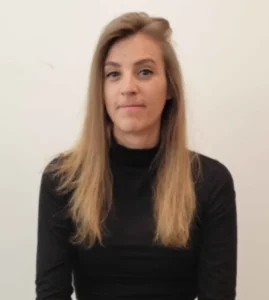
Talent: Lauren Lehmann
Role: Writer/Director
Which horror movie got you into horror?
Lehmann: The original It miniseries series from 1990 was my first introduction to horror films. But what really got me into horror were the Halloween parties my neighborhood would put together. As kids we would scour the surrounding blocks for candy, and everyone would be in crazy costumes and deck out their yards for the season. I will never forget the thrilling adventures we had on those late nights.
What inspired you to go into filmmaking?
I initially started my career animating video games such as Walking Dead: Onslaught, Westworld Awakening, Invincible Presents: Atom Eve, and many others. I often felt limited by the technical constraints of games where the end goal is functioning software. While I enjoy the interactivity as a player, it feels limiting as an animator. Choosing my own camera angles and focusing on storytelling first and foremost is what makes filmmaking so compelling for me.
How did you come up with the story for 3face?
Last Midsummer Scream in 2025, I met the real 3Face in the Hall of Shadows. We later connected on social media and brainstormed the initial idea for this short film. I drew most of my inspiration from the scare actor himself, but also from abstract cosmic horror like Stephen King‘s novel It and the 1982 film The Thing.
With your background in indie video games and deep passion for immersive horror experiences. How did you blend the two in your film?
I am very passionate about immersive horror experiences. I initially began my work as an artist creating worlds for VR games. These are highly immersive experiences in which the player interacts directly with the world, characters, and story. Following that same passion, I started scare acting last year as the high priestess at the Los Angeles Haunted Hayride. I continued to pour that same passion into my film through the subject matter and in the shot choices and atmosphere. I utilized many of the techniques I learned over the years of crafting interactive stories.
What do you hope the audience will take away from your film?
Scare actors and their haunts deserve bigger stories. In animating this short film about a real scare actor in the local SoCal area, I hope to inspire more people to explore the numerous haunts other than just Hollywood Horror Nights. There are so many haunted attractions out there, and they each have their own chilling tales to tell!
Catch and Release
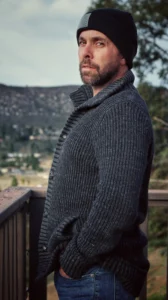
Talent: Chris Morris
Role: Writer/Director/Producer/Actor
Which horror movie got you into horror?
Morris: I would have to say the classic 80’s slasher movies got me into horror. Nothing like having sleep overs as a teen and staying up late watching Friday the 13th and Nightmare on Elm Street.
What inspired you to go into filmmaking?
It was The Ring that got me interested in filmmaking, and not as a filmmaker per se, but as a composer. I was watching The Ring in the theater and realized that the music was the reason I was scared or anxious as I sat there watching. After that, I began scoring small films. It wasn’t until October of 2025 that my partner and I decided to give actual filmmaking a shot. We were at Halloween Horror Nights at Universal, and saw that The Terrifier, which is a low-budget film, had their own haunted house! We looked at each other and said, “I think we should give this a shot! Maybe WE could have a haunted house modeled after one of our movies one day!”
How did you come up with the story for Catch and Release?
Honestly, we had a camping trip to the desert planned, and we thought we’d be foolish to waste that type of location, so we brought the gear, and came up with a story. The story for Catch and Release came about from multiple sources, as many stories do. It started with an idea: What if a man fell from the sky in the middle of nowhere and was running from an unseen creature? Then we added to that story in ways that would complement the location, until it reached its current form.
How do you maintain a high level of tension and suspense visually throughout your film?
The fact you used the word “visually” is tripping me up a bit, because having come from a composer/scoring background, I believe the music and sound play such a huge role in maintaining suspense in a film. But, in the spirit of your question, using techniques such as quick cuts, tight/suffocating shots, camera movement, negative space, and the fact you never really see what he’s running from, all lend to the suspense in the film.
What do you hope the audience will take away from your film?
This being our first film ever, I’m really hoping the audience walks away with an appreciation of our efforts to get filmmaking techniques right. This is an art form, and it’s not easy. We did our homework and really tried to learn and make our way through this process, from the filming, all the way to editing and sound design. For us, this really isn’t about the story as much as it is about the art of making a short film and making something that people would be willing to sit and watch for three minutes. If they enjoy it after the fact, fantastic!
Dead Jeni
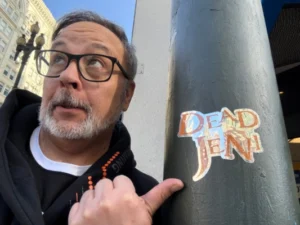
Talent: Alex Brewer-Disarufino
Role: Writer/Director
Which horror movie got you into horror?
Growing up, horror media was always around me. My mom was a huge fan, so the house was littered with horror comics, paperbacks and the usual occult literature of the time. We would make a big deal about staying up late to watch old horror movies and eat junk food. It was our bond.
As far as films go, when I was 10 years old, I saw the original Texas Chain Saw Massacre at a midnight screening. I guess there was no babysitter that night. It was like a switch flipped in my little brain. Instead of being scared, I began to analyze it. Why was it so scary in the daytime? Why was the slam of the metal door after Leather Face brained that guy so jarring? How come the frenetic dinner scene at the end made it feel like my head was going to explode? I absorbed the set dressing and the entire vibe of that film, like I was taking notes. After that horror movies did not scare me, they fascinated me.
What inspired you to go into filmmaking?
I am Gen X so the original The Evil Dead is what sparked me. This was before Ash became the iconic smart ass hero he is today.
Nobody was prepared for the ferocity of Sam Raimi’s debut, no one had seen anything like it, ever. This was less of a film and more like something bursting out of the bushes to grab you. You could feel the DIY, punk rock energy that went into every frame. Each shot is a masterpiece, and the soundscape immersed you in dread like nothing before.
I recently read something that author Josh Mallerman (Other Mommy, Bird Box) said about The Evil Dead and it really resonated with me. It was something to the effect of “I don’t know how anyone could watch the Evil Dead and not want to immediately pick up a camera and shoot something”. Bullseye Josh. Bullseye.
Later, for Dead Jeni, I would steal a page from The Evil Dead’s book to raise funds for the project. The iconic poster image of the woman and the hand bursting out of the grave is not in the film, but part of a series of promo photos they took to help shop the film around. Before I shot a single frame of Dead Jeni, I did a similar photo shoot for its crowdfunding.
How did you come up with the story for Dead Jeni?
At its core Dead Jeni is a vicious story about human kindness, an exploration of cruelty and accountability. If you look at the world around us, especially now, it is filled with intentional cruelty that goes unchecked and unpunished. Dead Jeni was created in response to this. She is the chaotic evil avatar of vengeance for the wronged. A suburban Golem, summoned to right wrongs and make the someone pay for what they did.
The colors used in the film remind me of the cinematography of Mario Bava films. Was that an influence?
First of all, thank you. And yes, absolutely. I definitely wear my Bava and Argento influences on my sleeve with Dead Jeni. I have always been drawn to saturated colors, either inspired by the just referenced Italian masters or the deep red glow from the brake light on my car. My father was a painter and always told me, no matter what it is, paint it in big, bold strokes.
Bava impacted Dead Jeni in another way that I did not even realize at the time. The poster/key art is a direct homage to the poster of Bava’s Black Sunday. That poster is such a beautiful and striking image, and it totally snuck its way in subconsciously.
What do you hope the audience will take away from your film?
Aside from hoping they love it? I would hope they appreciate the characters and the sentiment of the story. Moreover, I hope they see the talent and resourcefulness that went into it. I wrote and directed it, but it is not just me up on that screen. With Dead Jeni, I was followed into the night by an incredible crew of actors and technicians. I was blessed by so many skilled people who believed in the project and chose to be a part of it.
Dual
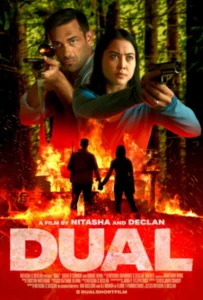
Talent: Nitasha Bhambree
Role: Writer/Director/Producer/Editor
Talent: Declan Mulvey
Role: Writer/Director/Producer/Editor
You’re well known for your work in stunts. What started both of your interests in stunt work?
Mulvey: I grew up watching action movies like Commando and Rambo and would re-enact the scenes from their movies with my toys. I started training in martial arts, and in high school my friends and I would shoot action movies on a VHS-C camcorder. At NYU I majored in Film Production and Cinema Studies, and of course all of my projects were action-driven. One of my teachers introduced me to a stunt coordinator, Tim Gallin, and that opened the door to my first professional stunt job.
Bhambree: When I was in high school, I started training in Tae Kwon Do. During college at NYU, I majored in Dramatic Performance Studies. But I didn’t connect the two until I realized how much I enjoyed physical performance. I wanted to be an action hero, and I realized I could do that by becoming a stunt performer.
I was interning at a casting agency, and they were looking for martial artists for a commercial. I asked if I could audition, and I booked the job! That began my career in stunts.
What inspired you to write and direct Dual together?
We’ve worked together for our entire professional careers, starting back in the 2000s when we made two straight-to-DVD independent action features. Fortunately, we can say that we work well together! So, it was a natural transition for us to go from stunt coordinating and second unit directing on studio shows to writing and directing our own projects. It was time for us to try to evolve in our careers and show what we could do as filmmakers.
How did you come up with the story for Dual?
It started from a very practical approach of having a single location and limited cast. We had a kernel of an idea for a scene: a couple who’s taken shelter in their cabin in the woods during a global crisis has to split up. The husband leaves, but the wife must stay because she is pregnant. The husband returns, but the wife isn’t sure it’s him. We asked ourselves, “How does one go about proving that they are who they say they are?”
We then fleshed out more ideas for the world and more dramatic situations for the characters. We didn’t realize until we got into the edit that it also became a very personal story reflecting our own anxieties about family and home.
We have feature plans for Dual, but we’re currently in prep on a very different kind of movie – an action-horror feature titled Let’s Take a Walk in the Dark. We’re filming this fall, but we’ll be coming back to Dual in the future as there’s so much more to explore!
When choreographing stunts, what are the challenges of creating stunts in a smaller or limited space?
Confined spaces can actually be some of the most challenging places to choreograph stunts. You have to find a way to make the action feel exciting without relying on large movements. There’s also very little margin for error, so every movement has to be precise to keep the performers safe. That being said, any limitation becomes a creative starting point. The enclosed space becomes the motivation for each movement.
In Dual, we begin the Keira fight in the doorway, face-to-face. Other Keira is literally and figuratively trying to take over Our Keira’s space. Our Keira is backed up and falling over her furniture. When she gets the upper hand, they immediately run into a wall. We used the limited space to create moments and keep the fight intimate and personal.
What do you hope the audience will take away from your film?
We hope audiences have a lot of fun with the film but also find themselves wondering what they would have done in the characters’ shoes. Would they have made the same choices to protect their family and home? There’s no easy answer, and that’s what makes the conversation interesting.
Eggsecution
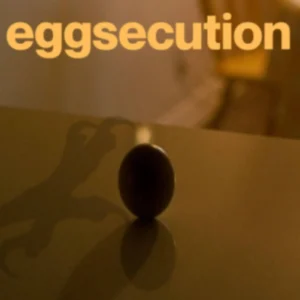
Talent: Bao Le Cheok
Role: Cinematographer
Which horror movie got you into horror?
Cheok: This is actually a funny question because, for the longest time, I was terrified of horror films. I can still remember my friends convincing me to watch Drag Me to Hell when I was about thirteen or fourteen. I spent most of the movie hiding behind my backpack, peeking out only occasionally. The one image that stayed with me all these years was the old lady vomiting brown goo and bugs all over the protagonist’s face. Safe to say, I wasn’t exactly a horror fan after that!
Everything changed when I was nineteen. A close friend of mine, Gloria—who looked like the sweetest, most innocent person you’d ever meet—introduced me to Hereditary. She was probably the last person I expected to love horror, but in hindsight, she completely changed the way I looked at the genre. What struck me wasn’t the scares. It was how deeply human the story felt. Beneath all the supernatural elements was a devastating story about grief, loss, and family.
At some point, I stopped watching it as a horror film and started seeing it as an emotional drama that just happened to use horror as its language. That was the moment I realized horror isn’t the end goal—it’s just the medium. Ever since then, I’ve become fascinated by how horror can explore emotions that are sometimes difficult to express through other genres. It’s a playground for visual storytelling, and I don’t think I’ve looked back since.
What inspired you to go into cinematography?
Looking back, I think my dad unknowingly started everything. When I was young, he gave me my first camera—a simple point-and-shoot. It wasn’t anything fancy, but suddenly I had this little box that allowed me to frame the world however I wanted. I didn’t realize it then, but I was already learning how perspective could change the way people experienced an image.
When I entered the Nanyang Technological University (NTU), the School of Art, Design and Media, I was convinced I was going to become a photographer. Then I met two incredibly talented animators (one of whom was Gloria again) and together we made this hilariously terrible Blair Witch-inspired short film for class.
It was chaotic. It probably wasn’t very good. But I absolutely loved every second of making it.
That experience introduced me to filmmaking as a collaborative art form. I realized I wasn’t just interested in taking beautiful images—I loved creating them alongside other people, all working towards the same story. The camera has always been the tool I feel most connected to. As a cinematographer, I get to shape how an audience feels without saying a single word. That’s something I’ve never stopped falling in love with.
How did you become a part of Eggsecution?
Eggsecution really began as my own quiet rebellion against conventional storytelling. As part of the cinematography program at the American Film Institute Conservatory, every Fellow is required to create a 35mm visual essay as a graduation project. We pitch our ideas, refine them with faculty, and eventually bring them to life on film. I knew I didn’t want to make something safe.
The project eventually became the brainchild of myself and my co-writer, Nicholas Thomas. We’d previously worked together on another wonderfully bizarre comedy-horror short called Snow Dad, so asking him to collaborate again felt like the easiest decision in the world.
Once the script came together, Japhet Velazquez joined us as director. I’d wanted to work with him ever since we met because his passion for horror and genre filmmaking was infectious. He immediately understood the strange tone we were chasing and elevated the project in ways I hadn’t imagined.
From there, the film became an incredible team effort. Production designer RJ Ragampudi, editor Bo Wen, sound designer John Chalfant, composer Ross Bugden, costume designer Kai Burns, SFX artist Daniel Sukara, food stylist Wendy Zhuo, co-producer Michelle Levinger—and so many others—helped transform a bizarre little idea about eggs into something far bigger than I ever expected.
This film relies heavily on bright colors. Considering how bright colors typically feel happy, how do you make bright colors feel creepy?
That’s a really sharp observation, and it was actually one of the core ideas behind the film. One of my biggest inspirations was Midsommar. Ari Aster proved that horror doesn’t need darkness to be unsettling. It’s relatively easy to scare audiences when they can’t see what’s hiding in the shadows. It’s much harder when everything is brightly lit and fully visible.
For Eggsecution, I wanted audiences to feel like they could see everything… and yet still have absolutely no idea what was about to happen next. That’s why we leaned into this exaggerated Americana aesthetic—bright yellows, pristine whites, beautiful food, cheerful kitchens. We wanted the visuals to lull audiences into a false sense of comfort before gradually pulling the rug out from under them.
I was incredibly fortunate to collaborate with an amazing team. RJ Ragampudi’s production design, Daniel Sukara’s practical effects, Kai Burns’ costumes, and Wendy Zhuo’s incredible food styling all elevated the world far beyond what I had imagined—especially considering our limited budget.
The bright, colourful aesthetic almost becomes another character in the film. It desensitizes you before confronting you with something grotesque. I love that contradiction.
What do you hope the audience will take away from the film?
Honestly, I just hope people feel something. Whether it’s laughter, disgust, fascination, or genuine discomfort, I think horror is at its best when it provokes a reaction. If people leave the cinema talking about what they just watched, then we’ve probably done our job.
And if anyone walks out of the theatre feeling just a little more suspicious of eggs or just wanting to eat more eggs (?)……well, welcome to the club.
The Long Island Sausage
Talent: Jeremy H. Lucas
Role: Writer/Director/Producer
Which horror movie got you into horror?
Lucas: My horror spiritual awakening was Hellraiser II. I wasn’t able to handle horror up until my early 20’s, always walking out if it got too gory. When Julia crawled out of the mattress, I was no longer afraid. It’s like I found a puzzle piece, and it all connected. And now I get giddy when there’s copious amount of comical violence.
What inspired you to go into filmmaking?
I love making people laugh. It’s my purpose in life. Since I was a kid, I always wanted to be in film. A lot was going on in life, so I didn’t let myself realize my dreams until my 30’s. I was traveling in the circus (one of my dreams now completed) and I knew there was the big one that has always lingered in the back of my mind. Film. So, I threw out my back, came back to Cali, and somehow got a film degree at a community college.
How did you come up with the story for The Long Island Sausage?
Me and my best friend/co-writer love playing a game where we throw random/made up movie titles at each other and we see what comes up. He texted me “the long island strangler” and I read it as “the long island sausage” and wrote the script in 20 minutes. It was practically final draft on first draft, somehow it made perfect sense.
To me, your film feels like Attack of the Killer Tomatoes meets Troma Entertainment. Were those the styles of comedy horror you were aiming for?
Thank you! And truth be told, I write what makes me laugh. I fondly refer to my writing style as Chekov’s cat (aka Schrodinger’s gun). It’s an amalgamation of comedy and chaos. If you can predict my next joke, I’m not doing my job.
What do you hope the audience will take away from your film?
I hope the audience wholeheartedly enjoys this short. It was a lot of love put into this. This movie was hit with every problem you can imagine (I was on my second skeleton crew still building set on film day one, and that’s far from the worst part of the experience.). I want the audience to know, no matter what life is saying, no matter what it’s throwing at you, be stubborn.
Fight every step of the way. And if that answer is too wonky, let’s try this one – If there’s something to take away from this short please, by all means, tell me what you took away. I wanted to make a silly film about evil sausages; there isn’t much past the surface level. Ok, that was a lie. The sausage is an allegory for childhood trauma. The turning other people into sausages is a representation of something or other I don’t know, it’s a goofy film about sausages. Take away laughter.
Monster Medicine
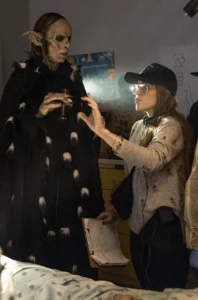
Talent: Veronica Felicity Johnson
Role: Writer/Director
Which horror movie got you into horror?
Johnson: I’ve been obsessed with all things horror and Halloween since I was five years old when my kindergarten teacher called my parents in to raise concern about the bloody Halloween story I painted. I was nine years old when I saw Van Helsing with Hugh Jackman at the movies. From then on, I was hooked on horror.
What inspired you to go into filmmaking?
The power of the magic of the movies. “For as long as I can remember I always wanted to be a gangster filmmaker.” I wrote short stories, scripts and plays since I was a child and honed my skills at the American Film Institute in Los Angeles.
How did you come up with the story for Monster Medicine?
I’ve always been inspired by the classic monsters of Universal Pictures— such as the suave Count Dracula, the bewildered Wolf Man and the innocent but lethal demon of Frankenstein’s Monster. I wanted to create a dream project where, just like Dr. Frankenstein, I could piece together my own world, where the creatures’ (human and otherwise) lethality and indifference would be matched by their vulnerability and compassion.
I knew that these monsters needed to be scary— and created a twelve-minute slice of life in a Los Angeles urgent care, with the thrills and chills of worlds colliding. Here, the inhabitants provoke fear but also inspire empathy. Here is a world that presents the supernatural at face value. And those faces are frightening.
The monsters in your film are beautifully gothic. What inspired their looks?
I wanted very unconventional and unexpected looking monsters, especially for our wolf character named Luna. When actress and movement expert Andi Norris came in to audition for Luna, she had bleach blonde hair. I immediately knew that our wolf woman also needed to have bleach blonde hair, coupled with a grunge look to her in her fully transformed state. To complete her look, we decided not to use a typical werewolf prosthetic or nose, but rather a mutant type of prosthetic that we accessorized with a longer bleach blonde wig, wolf hair on her face, black eyeliner, red contact lenses and designed a distinctive scar on her cheek.
For the Vampire Doctor played by fan favorite Kevin Keppy, his look and presence and how he commands the room is majestic. We crafted a more intensified and aged version of an amalgam of vampires in films through the years. He’s got a shaman-like quality to him, especially with his wardrobe that I coordinated.
For the Zombie Doctor (Kamy Bruder), I imagined him laying as a bony corpse for centuries who has just been excavated. He’s not a bloody, fleshy looking zombie with gooey blood coming off his prosthetic. I imagined the Zombie Doctor crawling out of the ground needing a cup of water to clear his parched voice instead of chomping on human flesh. If he moves his fingers too quickly, they will snap off like dust. That’s why he walks slowly with a wooden cane.
What do you hope the audience will take away from your film?
There’s a lot to think about. Sometimes the best intentions and better angels of our human nature can provoke the worst outcomes and fiercest demons. No good deed goes unpunished in this film. Unfortunately, it’s a dog-eat-dog world. Or in this story—wolf eat doctor kind of world.
We demonstrate that you don’t have to be human to be humane. In our short film, the monsters and humans share more traits than either wish to admit.
Take My Hand
Talent: Ryan Barri
Role: Writer/Director/Producer
Which horror movie got you into horror?
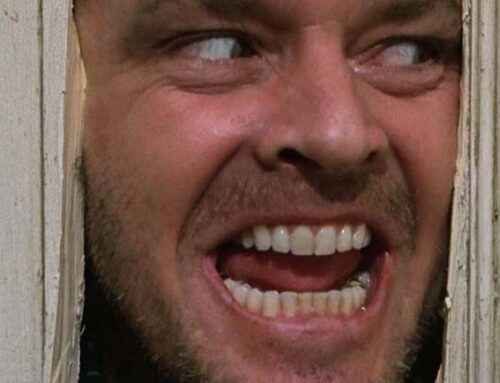
Barri: So many played a part, but The Shining was the one that showed me the true potential of the genre.
What inspired you to go into filmmaking?
Just watching movies at a young age and realizing how much was being communicated to me through means other than speaking – as though cinematic language was my first language.
How did you come up with the story for Take My Hand?
It’s actually from my childhood! I have this vivid memory from when I was four of a hand reaching out from under my pillow and curling its finger as if luring me to come with them. I refused of course because I was too scared, but I’ve always wondered what was really under there….
The stop motion is incredibly imaginative. What inspired you to make a stop motion film?
Ever since I was young, I used to take pictures of my action figures as though they were in a movie. I used that technique later on for storyboarding and once online editing became a thing, I’d cut them together adding sound and music and lo and behold, they took on this new form.
I was never trained in animation – I actually can’t draw – but I like how it forces me to be deliberate. I make these on my own, so every shot is labored and meant to convey as much information as possible within a unique set of constraints.
What do you hope the audience will take away from your film?
That you can tell original story with nothing but toys, lights, and an iPhone.
Wall Udder
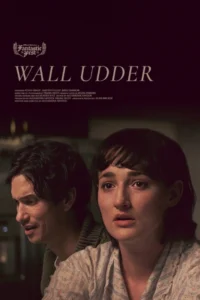
Talent: Alexandra Hayden
Role: Writer/Director
Which horror movie got you into horror?
Probably Ghostbusters was the earliest. I loved the way all the ghosts looked, there was nothing else like it. And then later it was The Fly on late night TV. Being spaced out with commercials somehow made the movie more drawn out and grueling, it felt taboo, yet I couldn’t help but watch it.
What inspired you to go into filmmaking?
Growing up I didn’t have a lot of people like me, but I spent a lot of time watching movies and they were my door into so many other viewpoints. I think that’s what motivates me being on the other side of it is putting something out that connects with someone and builds community.
How did you come up with the story for Wall Udder?
I love practicals and my friend Aelita Parizek is an incredible artist, so I knew I always wanted to do something centered around that. I don’t know exactly where the wall udder came from, but it’s such an evocative and loaded concept that I knew it had the juice to carry a story. Then I thought, why not drop a wall udder into a melodrama like Marriage Story?
How important was it to have the wall udder look as realistic as possible, versus having it look like a standard electric kitchen appliance?
Well, you can’t suck a regular kitchen appliance so that was off the table. Realism was very important to me though. Every aspect of the film we tried to make as grounded as possible, because that heightens the disconnect with the audience and makes it funnier while also bringing out deeper themes.
What do you hope the audience will take away from your film?
Above all I want people to have a memorable shared experience in the theater. There’s a lot of layers to the film and deeper themes that are there for folks to dig in to. But ultimately, I want to give audiences an emotional moment of value whether that’s fear, laughter, disgust – or some confusing combination of everything.