Live from New York Comic Con, the questions, comments and concerns over the latest aquatic survival horror Whalefall were addressed by the cast and creators. Within one hour, the presentation on the convention’s Empire Stage transformed from informative to “comic con therapy” as audiences discovered the guts of Whalefall’s emotional baseline.
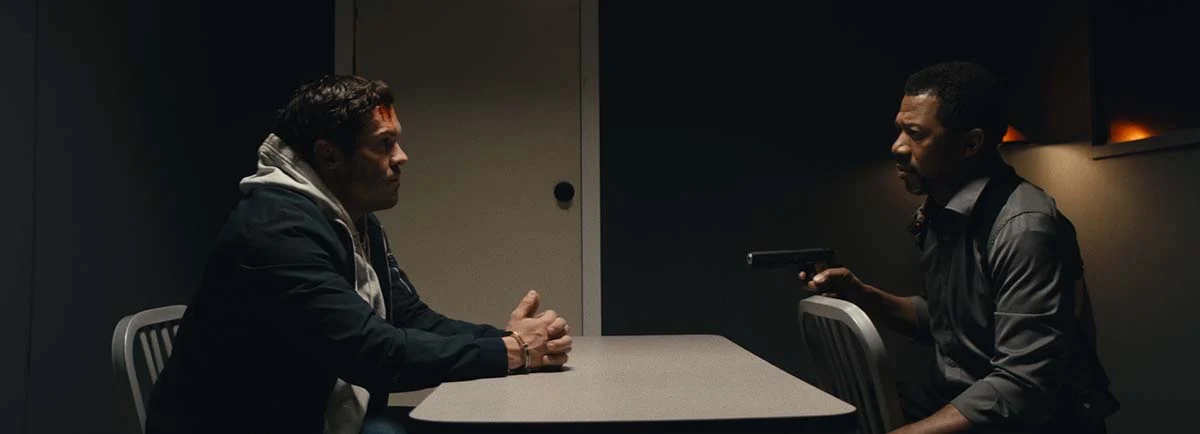
The panel featured director and producer Brian Duffield and co-writer and author Daniel Kraus. The creators were joined by stars Josh Brolin and Austin Abrams, who take on the heavy roles of late father and estranged son in one of the most unconventional settings to hold a story of familial forgiveness and healing after loss.

Kraus admitted the novel was inspired by a viral video of a diver who narrowly escapes being swallowed by a whale. Diving down the rabbit hole, and with support from the marine mammologists who’d humor him, the author discovered that to a lesser extent, it happens. The story that’s on shelves today, and coming to theaters soon is nowhere near fantastical like Jonah or Pinocchio’s, but is based on biology, and is as scientific as fiction can get. “I don’t mean the swallowing part, but divers and kayakers do end up in the mouths of whales. I saw one of those videos and thought, ‘Is there actually a way that some whale could swallow someone? And if so, is there a way that person could survive?'”
Kraus has written 30 books in his career, but claims to have been totally content knowing that Whalefall would be least likely to be adapted. Enter cinematic mad man Brian Duffield, who after 2023’s No One Will Save You, has returned to film the unfilmable. He shares a co-writing credit alongside Kraus, which they both agree is a cheat code to a successful story. “The thing that’s beautiful about what Daniel came up with” says Duffield “is that it’s the most extraordinary setting for a movie, and it’s the most universal story possible.”
The term adopted to name Kraus’ novel and its adaptation, “Whale fall” is what’s used to describe the death and decomposition of a whale. Postmortem, their bodies sink to the ocean floor and create a “concentrated pulse of organic nutrients”, transforming the otherwise nutrient-poor seafloor into an oasis for decades of life afterwards. The cast and crew all found this moving, as most can agree that those who give and receive support in complicated ways can still gift foundation to the future, even after death. It’s not all computer wallpaper material that Whalefall is about.
As real as that message is, it can be uncomfortable in an interpersonal context. Josh Brolin’s performance doubles as the subject’s late father, but also an allegory to the whale that won’t let go. He specified the film as a “party of discomfort” that holds the viewer’s physical and emotional senses hostage. Creating the multiple stomachs of the sperm whale for Austin Abrams to perform in was an enormous spotlight on the panel discussion. Abrams filmed his audition from inside a tent to add more immersion to his tape, which was a cute prerequisite to the 360 degree flesh chamber that Weta Workshop and members of production created after studying a number of whale autopsies.
Besides the source material, Kraus offered a big lift to pre-production visuals. The art department’s stomach designs were too big, and more in line with fantasy and less biological truth. To better illustrate the ratio in mind while writing the novel, he rolled up a yoga mat from his office and jammed a Barbie doll inside. The final product looked like giant trash bags on the outside, but on the inside… well, you’ll see. By way of puppeteering, the stomachs constricted, yanked and chewed Abrams up for two months of filming, translating to most of the 98 minute runtime. And yes, Duffield still has the tangible guts in his North Hollywood storage unit.
Whalefall sinks to theaters nationwide on October 16th.