1,000 Women in Horror, the newest Shudder documentary, highlights the impact of women in horror cinema.
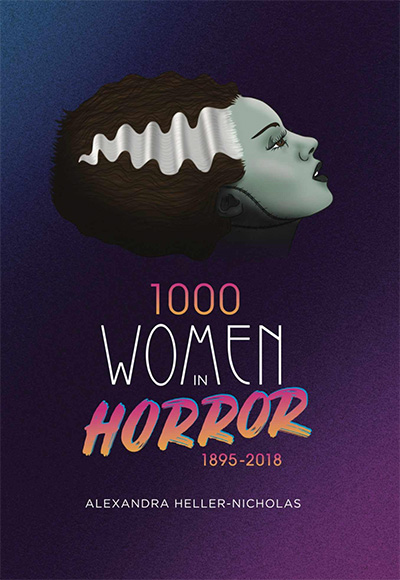
Based on the book of the same title by author Alexandra Heller-Nicholas, 1,000 Women in Horror gives a unique perspective on women in horror, intertwining groundbreaking filmmakers to modern day indie filmmakers to the impact of women on-screen. They intertwine the beloved classics and lesser-known films, giving horror fans an eye-opening insight of just how much women influence horror and how horror is influenced by the female experience.
Heller-Nicholas is a film critic and author specializing in the topics of gender and genre cinema. Her authored books include Masks in Horror Cinema: Eyes without FacesandThe Cinema Coven: Witches, Witchcraft and Women’s Filmmaking. Director/producer Donna Davies is a known for her directing and producing for independent documentary filmmaking, TV and horror. Her documentaries include Nightmare Factory (2011) and Fanarchy (2015).

Davies and Heller-Nicholas share with us what got them into horror, how this documentary came to be, and what they hope audiences will take away from this documentary.
Bonilla: What was the movie that got you two into horror?
Heller-Nicholas: So, I was not allowed to watch horror as a child. My parents were very strict Catholics, but my dad thought war movies were fine because they were, I don’t know, historical or something. I don’t even know, like, it’s too weird to get into. But we watched, I was about eight years old when I saw Apocalypse Now on VHS, and on that tape was a trailer for The Shining. And I don’t know if you know the trailer, but it’s non narrative. It’s just a shot of the foyer with the blood coming down in front of the elevators. And it absolutely broke my brain. Like that was it. This feeling is terrible, and I want to feel like this all the time. That was it for me.
Davies: Oh, my goodness. And for me, I was enthralled in scary movies, but I knew that I wanted to start making horror films. It sort of took an evolution for me. And it kind of happened when I saw Ginger Snaps. And it was done in Canada. I was like, “What! We can do this here!”
But before that, just about anything that came out, I was a fan of. It started with the hagsploitation films, you know, Whatever Happened to Baby Jane, and all those old films from before. But I think that anything, if there was any kind of blood and guts in it, or if everyone else was sort of grossed out by it, I liked it. And therefore, it was easy to fall in love and pick a side road.
Donna, is that what inspired you to go into filmmaking?
Davies: Yeah, I think that I went into filmmaking to make drama. And then when I used my first credit card to get really far in debt with the first few, I made a documentary, and that was really successful. It was about women. It was called Kitchen Goddess. It was about psychics and fortune tellers and that sort of thing and witches. And it sold all over the world. It did really, really well. And then it was like, “Oh, I can use this to, you know, do subjects I like.” But definitely it was my desire to scare people. [It] was in my original desire to make films. And all of the scripts I’ve got, which, dramatically speaking, are all in the horror genre.
What inspired the book 1,000 Women in Horror?
Heller-Nicholas: I’d already published quite a few books. And my first book was on rape revenge film. I’d written a book on Abel Ferrara‘s Ms. 45. I’d written a couple of other books as well. But obviously, gender politics was very central to the things that I was interested in writing about. And I just wanted to do something a bit different. I wanted to do something a bit more fun, a little less academic, and I had written a bunch of books on horror and exploitation.
I’d also had a very deep research interest in women’s filmmaking. I’d worked on a book, I co-edited a book on Elaine May, who’s very much not a horror filmmaker. And it felt like those, all of these things just sort of came together quite organically.
And I had a friend called Lee Gambin, an Australian film critic who died a couple of years ago. He really championed this idea. He was like, “This book has to happen.” And he introduced me to his publisher, who pretty much signed it on the spot, really, without even a proposal. It was just sort of instantaneous how it kind of came together. And to be honest, the book project itself, it’s sort of something about the title almost sold itself. Like there’s something about it that was so captivating, and there wasn’t really anything around like it at the time. It was just the right thing at the right time.
How did you two meet? Was it because of this film, or did you meet beforehand?
Heller-Nicholas: So, this is quite funny. Actually, I had a rule. Because there was only 1,000 women in [my] book, I had kind of set myself rules about who I would include and who I wouldn’t include. And I had a pretty solid rule that no documentary filmmakers. And one of the last things I did, I can’t even tell you how I had a bio written for Donna. And I put it in, and I took it out, and I put it in. And I think, like, the day before I submitted the manuscript, it’s like, “No, this woman absolutely belongs in this book.”
So, I already knew Donna’s name and I knew her work, but we’d never met. We’d never had anything to do with each other. And then when the book was optioned, and my producers came and said, “Hey, I think we’ve got a really great director”. And it was Donna. I just laughed. It’s like, of course, it’s Donna. It has to be Donna.
How did you decide on which films that were going to be talked about? Because there’s so there’s so many different avenues you could have gone. How difficult was that?
Heller-Nicholas: It was agonizing. It was hell, like it was actually. There were, like, four- [or] five-hour cuts of this with so many films in them. We knew that we had to have what we call tent pole films. You know, there will be riots in the street if we don’t have Halloween. There will be riots in the street if we don’t have Carrie. You know, we knew that there were these big tentpole films that we would absolutely have to have. And we almost use them as like, it’s not a great metaphor, but we almost use them like Christmas trees to hang little baubles off. It’s like, if we have these big, big, big films that people want, that gives us a little bit of wiggle room to be really creative with the lesser-known films, you know. Bring in indie films that maybe not everybody has seen or heard of. So, we were quite conscious about, and this is I think, a really driving theme of both the book and the film, this question of visibility. We really wanted to make things visible. But to be able to kind of get away with that, we did really need to have these kind of big name, big hitter films in there, to sort of give us the wiggle room to really kind of get these sort of lesser-known films in there.
I have to say, I really did appreciate you two putting in Poison for the Fairies. Because I feel like when we talk about horror from Latin America specifically, we don’t have enough of that.
Davies: Great film. Love it.
Heller-Nicholas: Kier-La Janisse talking about Poison for the Fairies is one of my favorite parts of the whole film.
What would you say was your favorite horror movie directed by a woman?
Heller-Nicholas: Good question. Mine changes every day, like every day. I think, you know, I would sort of default back to early things. So, things like, I think Lois Weber Suspense from 1913 maybe not my favorite, but it’s like everybody needs to know that film. That’s a home invasion film, starring and co-directed by a woman.
Germaine Dulac, The Seashell and the Clergyman. We wouldn’t have David Lynch without Germaine Dulac. And I think he would be the first person to agree with that. I mean, that is an incredible film from 1927 [or] 1928 about male toxicity, made by a woman filmmaker. Extraordinary film. Maya Deren‘s Meshes of the Afternoon.
This idea that women making horror is somehow a new phenomenon is so incorrect, you know. And we can go back to early silent films. Go back to Alice Guy-Blache to see just some amazing films.
Davies: I gotta say, I was a huge fan of Kathryn Bigelow’s Near Dark, and we got a chance to talk to her about that. And so that was a really big deal for me. But, yeah, there’s so many. I love Natalie Erika James, Relic. Like talk about a new film that like blows me away, because it’s so incredibly well done and so horrifying some of those scenes. I mean, just the idea of how the family can, you know, twist and turn on each other. So that’s one that I wanted to mention. I don’t think there’s anyone that’s not a fan of A Girl Walks Home Alone at Night [by] Anna Lily Amirpour. But yeah, so many and amazing films.
What is your favorite, or one of your favorite on screen female performances?
Heller-Nicholas: Look, it’s not original, but I think I just as a default setting, my favorite actor is Isabelle Adjani, and nobody does what she does in Possession, the closest that I can think would be Angela Bettis in May, which I think is one of the great, underrated horror performances. Those two films are Possession and May. If I needed to sort of offer two films to tell you who I am, they would be the two films. Adjani is an extraordinary performer, you know? I mean what she does in [Possession] is supernatural.
Davies: Even in that Subway scene, you can’t even. You really don’t have a clue. What if you saw it and you were from another planet? What the hell? What is going on here? It’s just so incredible.
Heller-Nicholas: It’s shamanic, like there’s something so ancient about the knowledge, the embodied kind of knowledge in her performance in that film, no performance from anyone of any gender comes close to what Adjani does in that film.
Davies: Amazing, absolutely amazing performance. What about you? You’re making me feel that you know one that we don’t know.
For me personally, I will always default to Spanish-language Dracula with Lupita Tovar as Eva.
Heller-Nicholas: Yeah, good call.
Because if we’re talking about representation, we’re talking about somebody that was breaking racial and gender restraints, especially of that era.
Davies: Yeah, oh my God.
Heller-Nicholas: That’s a great call. That’s a really great call.
I’m always gonna pick Lupita.
Heller-Nicholas: You know, even Ana Torrent in Spirit of the Beehive, which I think counts as horror, even though it’s not horror. But it is horror because of the, you know, Frankenstein stuff. Like Anna is just one of the great living actors. Just full stop, absolutely.
And what do you hope audiences are going to take away from this documentary?
Davies: Oh, I hope they’re going to take away the idea that the most exciting and interesting stories have yet to be told are probably by people that haven’t been given the opportunity to tell those stories yet. So, if you open up the floor and let some of the people in, we’re in for a real surprise. I mean, we’re seeing things that have never been seen before. We’re seeing perspectives that have never been seen and we’re giving those women that have already been there telling the stories. The opportunity to tell another one, or to tell them with bigger budgets. Or, you know, to have more of an opportunity to discuss their work.
And you know, [I’m] so thankful for all of these podcasts and shows and abilities online for women and people that don’t normally get a chance to talk to have this opportunity. What an amazing thing, because it means that the mainstream world of spreading just the same old story is going to be subverted, and we’ll have better stories to tell, to hear.
1,000 Women in Horror is now playing on Shudder.
You’ll find Justina Bonilla wherever horror fans gather: interviewing filmmakers, covering conventions and festivals, and reporting from The Screaming Room Film Festival at Midsummer Scream.