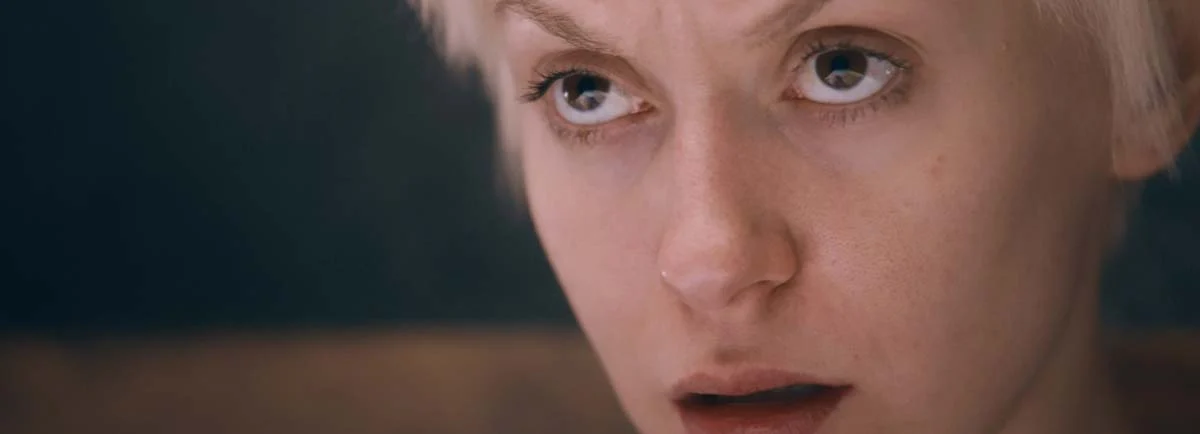
Writer/director Emma Higgins got her start directing music videos, so maybe it’s no surprise that her feature debut, Sweetness, tackles obsession, creativity, and music. The film stars Kate Hallet as Rylee, a teen who grieves her mom and finds escape in the music of Swedish pop star Payton, played by Herman Tømmeraas, best known from the Netflix series Ragnarök.
The film transforms into a dark coming-of-age tale about addiction and intense fandom. The cliché about never meeting your idols truly applies in this case. We spoke with Higgins during the Fantasia Film Festival about her background as a music video director, the film’s heavy themes, and the script.
This interview was edited slightly for clarity.
You have a background directing music videos, and this is very much a film about music, obsession, and creativity. Can you talk about your journey as a director and the journey of this film?
Emma Higgins: I talk a lot about music videos as a really great way for any filmmaker to get their foot in the door and build a reel and find their voice, which it was for me. There are very few barriers of entry. With music videos, it’s a very creative space. You can find a local band or artist who needs visuals. They need something. They’ll have a couple thousand dollars that you can rent a camera with, buy everyone lunch, and shoot something weird. Music videos have no rules. It allowed me to make stuff. I made a lot of music videos. I say to young filmmakers to just make something, and then you have to make something else and something else. It takes a while to find your voice.
I truly found my voice. I think a lot of that comes through in Sweetness, just in finding my sensibilities with camera, with color, with lighting, with framing, with a comfort of being on set and problem solving on the go. Musicians can be crazy people. If you can deal with insane musicians who don’t show up to set and have wild ideas, it trains you for indie film in a way I don’t think anything else quite can.

Was Herman Tømmeraas from the Netflix series Ragnarök always someone in mind for the role of Payton? Tell me about working with him, especially since his role here is so different.
Emma Higgins: We found him in the casting process, and when we did, I didn’t know quite what I was looking for entirely until I saw it in him. He was in Skam in Norway and in Ragnarök, of course. The deciding factor for me is that he read for the role and crushed it. The questions he asked when we discussed the character were informed and intelligent. He’s a very smart and well-researched actor.
He was also a professional dancer. I started watching him on stage in all these dance shows he was doing. He has the charisma. I could see the dark in the acting, but you have to see the other side of it, which is the sparkle, performer, and front man. He had it in spades. He just ticked every box and was lovely to work with. I think I won the lotto when I was introduced to Herman. He’s an angel.
Without spoiling anything, I wanted to touch upon the ways this film deals with addiction, destructive decisions, and even grief. What was it like handling some of those heavier themes?
Emma Higgins: There is a lot of heavy subject matter. Part of the inspiration was meeting fans at shows who were very intentional but hurt as well. When they would tell me that a band saved their life, they really meant it, in a very dark way. When they were perhaps contemplating suicide, a song pulled them from the brink of that. The music can really mean a lot to people and actually be a lifesaver. That is art at its best. I hope that’s what most songwriters are intending when they write songs that can connect with people that deeply.
Addiction itself, too, is not something to be taken lightly at all. Even though this is a fun film, there are themes of choice in it and doing the wrong thing. I think you see that often in both of our leads in the film. They have choices throughout the film to do one thing or the other, and they continue to make the wrong choice for themselves, whether it’s an addiction or obsession.
Kate Hallet, as Rylee, really turns in quite the performance here. What was it like working with her, and was she based on any specific music fans you met in that industry?
Emma Higgins: Working with Kate was incredible. She has an amazing career ahead of her. She’s really, really good at taking direction, even with minute changes, like the way she’ll do something slightly different with her eyes or the delivery of a word that can completely change the tone of a scene. She’s a very nuanced performer, which was very needed. The plot and story are absurdist. It needs to be balanced out with a very grounded performance. She holds that down.
In terms of the basis of the character, yes, it was based on meeting fans, but there’s a lot of me in Rylee. I don’t make the same choices she does, but I do understand. I grew up in the suburbs and remember being her age. I remember feeling very lonely and alienated and just really latching onto, for me, movies, and finding something that made me feel like I had a space I could belong in. It was living in movies for me. What she has for music, I had for films. Eventually, through film, I found my freaky deaky people that chose to make films for a living. It gave me a real sense of family, purpose, and belonging, which, for me, was a lifesaver. I can relate to that desire a lot. I think that gave me a lot of sympathy for the character, too.
Can you talk about crafting the dialogue for this film? It feels authentic, like how teens actually talk.
Emma Higgins: First of all, thank you. I’m really glad that came through. I had a little bit of anxiety about that. I’m very solidly a millennial writing a Gen Z, or maybe Gen Alpha character. I had a fear. You can tell when dialogue is written by someone older and not in touch anymore. I leaned on our actors a bit, but I did a lot of work in prep. We did a lot of table reads. We read through the script again and again and again. We had the words spoken aloud. I would like to believe, too, that I tried to make it a little more timeless. I didn’t want to put any very specific timestamped slang in there. Even with the technology, I didn’t want to do too much to stamp it. There is texting and phone stuff in there, but I didn’t want to get into anything that felt too in the moment.
Anything else that you’d like to add that we didn’t cover?
Emma Higgins: We really want to get more people to see the film. I talk a lot about who the audience is for the film. As a filmmaker, I think that if you’re trying to make a film for everyone, you’re going to fall short. I really made the film for my own teen self. That’s what I set out to make. Now it’s about finding other people, like music fans, genre fans, and horror fans, the girls as well. It speaks to this girlhood experience. It’s satisfying to know that I could make a movie that was designed for me and there would be people who would love that as well. It makes me feel seen. I’m just very grateful for the experience to show this film.