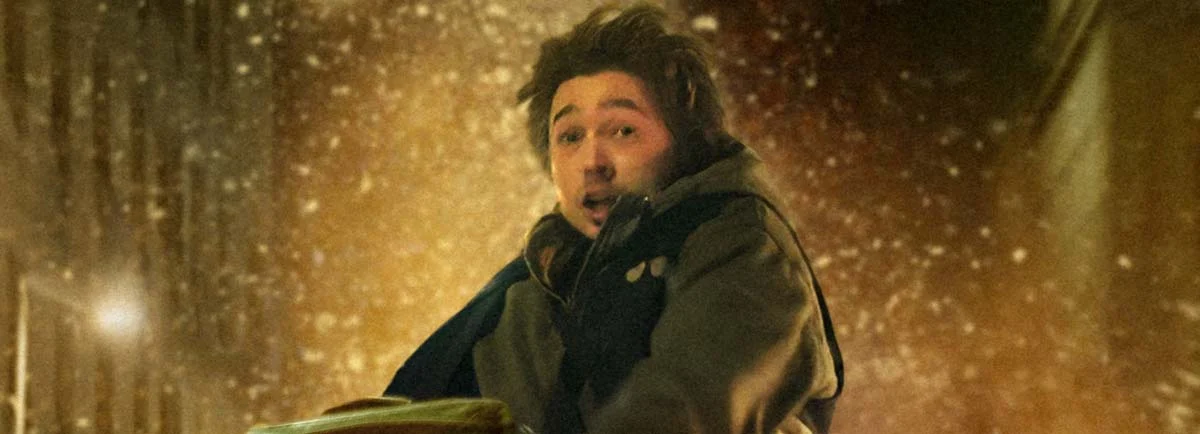
I’ve been actively avoiding writing anything about the movie WEAPONS simply because there’s been so many articles and reviews and all around buzz about the film that I didn’t feel I had anything to add. That was until today’s evening work commute, listening to a podcast which is 95 percent of my “radio” listening these days. Comic book podcasts, screenwriting podcasts, movie podcasts; I really could use a music break, now that I think about it. Anyway, the hosts were discussing WEAPONS in all its modern classic glory when a particular scene was brought up where the subtext seemed to elude them a bit.
The scene in question is something I had all but assumed I’d figured out the significance of until a new idea I hadn’t considered arose while thinking about it, pushing my pre-accepted theory to the side in favor of a slightly more nuanced interpretation. So, sit back and relax as I pitch my amazing theory that’ll probably be what many of you already assumed but, unlike myself, lacked the hubris to write an entire essay about. So take that, self awareness!
Let’s get these formalities out of the way and get into the crux of this. One night, at 2:17 AM, all of the students in Ms. Justine Gandy’s third grade class inexplicably woke up in their beds, opened their front doors and ran, with abandon, out into the night and didn’t come home. The next day, Ms. Gandy shows up for class but the class is empty except for one student named Alex. This sends the entire small town into a panic as tensions mount, horrific occurrences ensue, and Ms. Gandy draws the ire of concerned parents who believe she may be a key to solving the mystery of their missing children.
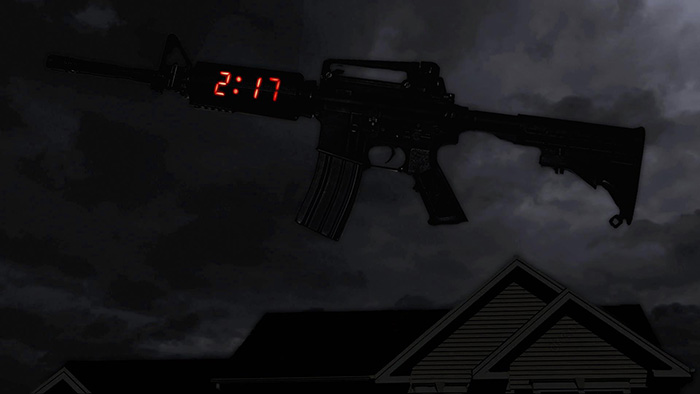
WEAPONS was one of last year’s biggest horror surprises from Director Zach Cregger, known previously for his bold, if divisive, 2022 horror film, BARBARIAN. As much as I enjoyed BARBARIAN, I thought WEAPONS was a major improvement in Cregger’s storytelling. Both BARBARIAN and WEAPONS were packed full of subtext and symbolism but it was the dream sequence of Josh Brolin’s WEAPONS character, Archer, that created a bit of confusion for some viewers. In Archer’s dream (nightmare), he chases after his son in the night through their upper middle class, suburban neighbor only to be led back to his own house. Above his house, an ominous sky roils as lightning strikes illuminating the shape of a giant AR-15 style rifle hovering above the house with a red, glowing 2:17 appearing on the foregrip of the weapon. Now, what the hell is THAT supposed to mean?
That was my initial question when I first saw that scene. The 2:17 of it all is the easy part. 2:17 AM was the time seventeen of the eighteen students from Ms. Gandy’s class ran from their houses, disappearing into the night. The two that were left from the class were Alex and Ms. Gandy – 2:17. But what about the damned rifle? My initial interpretation of it was that it was a rather on the nose reference to gun violence in the U.S. More specifically, the epidemic of mass shootings; school related or otherwise. Zach Cregger has gone on record to say this is not necessarily what the movie is about but has otherwise left the interpretation of it up to the audience. At the time, I didn’t buy it. I thought Cregger may have even been trying to avoid courting controversy by taking that stance, but now I think he was telling the truth and here’s why.
If we examine Archer and the archetype he represents, we can build a profile. He’s in the construction field which comes with its own assumptions about blue collar masculinity. We know that Archer regretted not expressing love to his son. We can assume from Archer leading the charge against Ms. Gandy and his exasperation as he pressures the police to do more, he views himself as the protector of his family and feels derelict in his duties. He’s desperately grasping for ways to find his child and make good on his unspoken promise as his protector. We don’t actually see a firearm in Archer’s possession at any point in the movie, but I don’t think it’s a far stretch to assume that maybe he is a gun owner. There are many people like Archer in our world. With the world being what it is, can we really blame them for wanting to find ways within their means to protect their families from the countless dangers, perceived or tangible, faced by society?
It’s in that regard that I believe the giant hovering rifle over Asher’s house serves as not only his personal avatar but also as a symbol of our collective failure to protect the children in our society. Biases often shape our ideas about who and or what ultimately would constitute a threat to our family’s safety and security. Is it our own government? Is it spill-over from the crime ravaged “urban areas”? Is it our neighbor down the street? You know the one. The biases we have that shape the outline of these perceived threats often blind us to the less conventional, yet equally as dangerous, threats we may face. You can’t blast a hole through partisan politics propaganda with a gun. You can’t wrestle anti-scientific disinformation to the ground. You can’t roust and roundup social media induced depression off the streets and send it to an internment camp. What’s worse is, many people don’t even recognize these as threats to the otherwise comfortable lives they lead.
In my opinion, the central theme of WEAPONS was how society uses children as pawns to further any number of political and social ideals but, often, the promise of safety and well being of these children is never fully realized, leaving them to bear the brunt of our failings as adults. The image of the gun represents our failed collective means to achieve that goal and how it will always loom large above us unless we forego symbolism, tribalism and bravado and actually take real steps–steps that just may go against some of our biases and prejudices–and truly do what must be done in the best interest of our society’s children, unborn and born alike.
Stephen Baker writes about horror on the page and on the screen: book and graphic novel reviews, plus essays on why some horror works and some doesn’t.