
Are we humans attractive to sharks as food? Definitely not. Are we afraid of becoming attractive anyway? Certainly. Hence the large number of horror movies telling stories underwater, almost always involving a shark. These poor animals are depicted as the monsters of the ocean, while a whale can eat a whole shark for lunch. Anyway, there are very good movies in this category that we decided to rank, along with one real, almost equally scary story from real life to prove that sharks and humans can coexist beyond horror.
The real water behind the movie fear
The real dive is worth talking about because it changes how we think about shark stories. It is not just scary or shocking. Leticia Bufoni was already known for balance, timing, and courage as an athlete before she went into the ocean. In O‘ahu, she joined marine biologist Ocean Ramsey for a guided free dive with tiger sharks, and this became one of the most viewed and discussed stories by the Team ignition podcast series.
This was more than a cool travel moment. It showed what happens when an athlete used to reading speed and small movements enters the ocean, where the signs are quieter and the stakes feel bigger. That is why this dive fits in a shark-horror discussion. It takes the classic image of one person alone in open water and makes it feel real.
What changes underwater is the kind of courage required. Street skating rewards commitment, but it often looks explosive from the outside. Shark diving asks for the opposite kind of control. The point is not to dominate the moment. The point is to stay readable inside it. Guides stress calm movement, steady awareness, keeping the animal in view, and understanding that posture itself sends a message. That makes Leticia Bufoni interesting here in a very specific way. She is not compelling because she acts fearless, but because she has to trade visible bravado for quiet discipline.

Profile
Who Is Ocean Ramsey?
Ocean Ramsey is a marine conservationist, free diver, and shark specialist from O’ahu.
 Her experience with sharks is not limited to one-off viral moments. Through One Ocean Diving, the Hawaii-based operation she co-founded in 2010 with Juan Oliphant, Ramsey works in guided shark encounters built around education, species identification, behavior reading, and field observation. The company says the team brings more than five decades of hands-on shark experience and that its dives include non-invasive data
collection such as ID photos and behavior tracking. That makes her role broader than that of a thrill seeker. She is presented as someone who mixes practice, repetition, and ocean knowledge in a setting where calm movement matters as much as courage.
A useful detail for this article is how Ramsey describes the physical side of that experience. In a 2025 PEOPLE interview, she explained that one of her core safety methods is “redirecting,” a technique shaped by past close encounters in which she learned how body position, eye contact, and spacing can affect a shark’s approach. That is the real-world angle that fits this piece so well. Shark movies sell panic. Ocean Ramsey’s work shows the opposite skill set: patience, control, and a deep familiarity with how sharks move through their space.
Ranking the films that still bite
At No. 5, Open Water remains the stripped-down nerve test of the group. It is almost punishingly plain, and that is why it works. At No. 4, 47 Meters Down turns bad visibility and shrinking oxygen into pure panic. At No. 3, The Shallows understands the value of clean geography and a ticking natural clock. At No. 2, Deep Blue Sea adds pulp energy without losing its teeth. At No. 1, Jaws still owns the crown because it understands a simple rule better than almost any horror film ever made. What you do not see keeps growing in the mind.
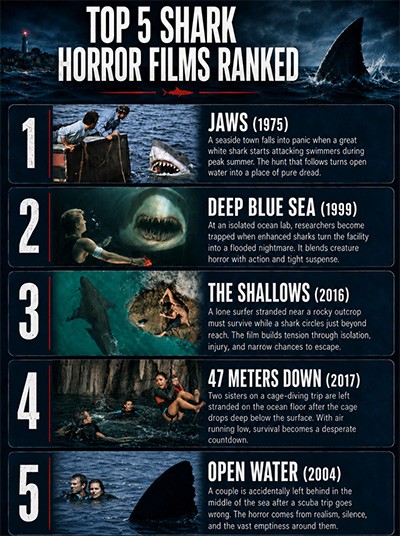
The numbers show how flexible shark horror can be. A tiny survival story like Open Water could still travel, while Jaws remains the giant shadow over everything that came after it. But the ranking here is about craft, not just earnings. Deep Blue Sea earns second because it turns a sealed lab into a funhouse of bad options, and because it knows intelligence can make a predator feel even more dangerous. Jaws stays first because it perfects withholding. It understands that the fin is scary, the barrel is scarier, and the wait is worst of all.
Why real shark data makes the movies stronger
One reason shark horror lasts is that reality never fully cancels the fear. The numbers are far smaller than the movies make them feel, but that does not make the ocean less charged. It makes the genre more interesting.
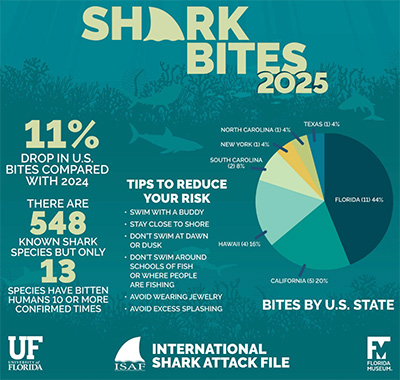
The Florida Museum’s 2025 report recorded 65 unprovoked shark bites worldwide, close to recent averages rather than some sudden wave of chaos. In the same report, Gavin Naylor of the International Shark Attack File offered a line that should sit beside every shark screenplay: “Out of the 1200 species, 30% of them are categorized as endangered.”
That double image is what the best modern shark films understand. On one side, there is a real animal, rare encounters, real stakes, and a living ocean. On the other, there is the human habit of turning uncertainty into a monster. Older shark horror often leaned on the idea of a pure villain. Stronger entries work differently. They treat the shark as an indifferent force, something wild that does not hate people and therefore feels even less negotiable. A shark does not need a speech, a grudge, or a supernatural twist. It only needs water, proximity, and one bad chain of human choices.
Reality makes the fiction sharper, not weaker
That is also why the real dive belongs next to the ranking. It sharpens the fiction instead of weakening it. Once the shark stops being a cartoon monster, the filmmakers have to earn fear through sound, timing, distance, and human behavior. The good ones do. The great ones make the water itself feel like a decision you cannot take back.
Shark horror lasts because it hits two nerves at once, movie dread and real ocean awe. The strongest films know that the water is frightening not because it is evil, but because it is alive.
