The US-Mexico Borderlands in Contemporary Horror, the latest book of the Edinburgh University Press 21st Century Horror series, evaluates the real and supernatural horrors of the United States and Mexican borderlands from an array of media from film to television to comic books to video games.
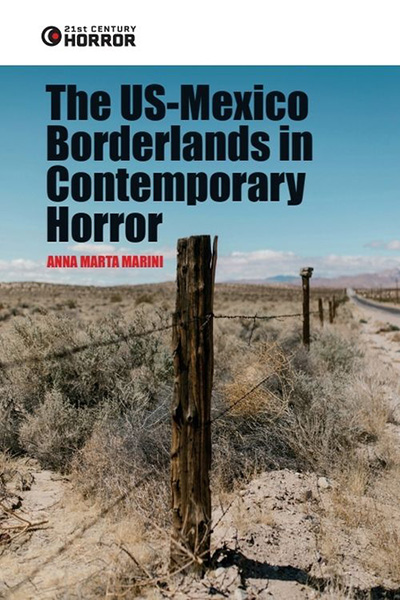
Since 1848, when the earliest form of the United States and Mexican border was developed, a unique culture was born, creating its own stories and horrors. Stories of mythical figures like La Llorona and El Chupacabra haunt our dreams, as the horrors of true-life migrant experiences and economic exploitation created living nightmares. Horror has had the unique ability to blend, explore, and expose the supernatural and brutal horrors of this nearly two-thousand-mile border.
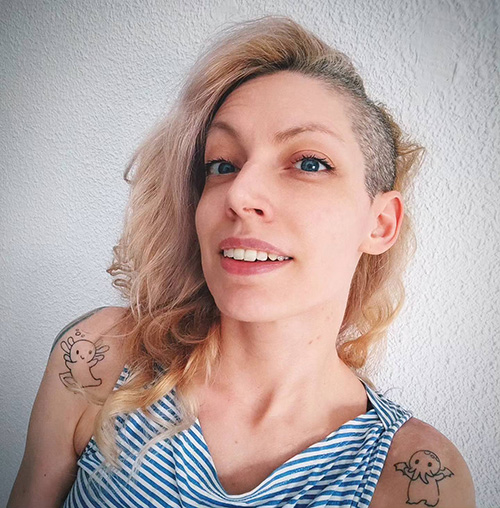
Dr. Anna Marta Marini (PhD)
Author Dr. Anna Marta Marini (PhD) is presently a Humboldt Research Fellow at the John F. Kennedy Institute for North American Studies at The Free University of Berlin. Her writings have been featured in several book chapters and journal articles. She was a co-editor the two 2024 essay collections Latinx Representation in Popular Culture and New Media and The Gothic in Twenty-First Century American Popular Culture.
Marini shares with us what inspired this book, how media impacts how we see the boarder, the influence of both supernatural and real-life horror on boarder culture, and what she hopes readers will take away from this book.
Bonilla: What inspired the idea for this book?
Marini: When I was writing this book, I was working on this at the same time as I was writing my dissertation which is about US cinema: US films that are set in Mexico, and how is Mexico represented in these films. There’s a very clear pattern and it’s a hero’s journey. So, people cross the border when they are going through a crisis or, I don’t know, they’re feeling like misfits, and then in Mexico something happens. They have to save themselves, of course, because the local population is always represented as helpless and unhelpful, and not good enough to help these protagonists, [the] US American protagonists.
And so, [the US American protagonists] save themselves, quite often they also save the locals, because they’re white saviors. And then they can go back to the United States as better people. And I was finding it’s across genres, but I was finding in particular so many horror movies that have the same pattern or characteristics, it was very similar and they were set on the border. And so, I started to, you know, make a list and take some notes on those. And eventually it turned into [this] book.
But actually, it was also the book that I wanted to read. I was looking for scholarship on borderlands horror specifically because to me it’s so obvious that it’s a locus of danger. That it’s so crucial, especially, you know in the past thirty years, thirty-five years, it’s been so critical in general, in popular culture, the order per se.
So, I was so surprised that there wasn’t anything truly on it as a theme. And that’s why [the book] is more than an in-depth analysis of specific texts. It’s a bit of an overview trying to build a bit of a framework, to look at this kind of representation and to categorize them. [To] see what are the common recurrent themes and how it does reflect the evolution of border real life horrors.
I read that you have several areas of research from political discourse and popular culture to horror and gothic medias. What inspired you to research them?
I actually come from Mexican studies. [In] Mexican studies I have worked mostly on racism and state repression from a critical discourse analysis lens. So, I sort of got to the border from that and I started to work on border enforcement, the discourses that justify anti-immigration measures and so on and so forth. And violence, of course. And the extra-legal practices that happen there against migrants in particular, but locals as well.
I’m always interested as to how these discourses are propagated through popular culture and mainstream popular culture. Because of course people form imaginations and ideas and opinions that then can become political stances that do have a relevance in the bigger picture. Even just by consuming these texts, you know. You watch a movie. And watch another movie, it has the same kind of representation. It starts to form an idea, even subconsciously, you know.
So, I was interested in how these messages about the border and the need to have a border infrastructure and a certain kind of militarization. To have this kind of enforcement. How is it communicated? How is it constructed through popular culture?
For this book, you researched movies and TV shows, but also video games like Call of Duty and comic books. Why was it important for you to also include these medias?
I do publish work on comics in general. But before this the stuff that I published was mostly on Chicane comics, mostly horror [and] gothic themes in Chicane comics. And then I started to see that there are these comics coming out, in particular, in the past ten years, that are purposely set on the border. And I thought that was very interesting, because some of them are independent and they’re really small [productions]. And while there are comparatively few people reading them, some are not that niche.
So, you know, I felt that they also contribute to this bigger discourse about the imagery of the border. At the same time, the ones that I focus on in the book, there are a couple that are still Mexican American comics. They are Chicane comics, broadly speaking. And I think they’re actually very interesting because they do give a different perspective. One of them was actually published by DC [see Border Town, published by DC Comics in 2018] and was canceled after four issues, because the very first page is making fun of Trumpian vigilantes on the border, and the reference is very clear.
I mean, there’s no doubt that they’re talking about Trumpian messages. I thought that was very interesting and had a lot of supernatural stuff, you know. There’s a lot of supernatural metaphors and how the border works, questioning what the border is.
And video games, to be honest, I’ve worked on video games, but not that much. I haven’t published anything yet, because I play video games for fun, so, I would like that not to turn into work. But it’s very hard to resist. And in that sense, mostly, I’ve worked on video games that represent migration, cross border, migration, and undocumented migration. It’s usually very small [independent] games, for good and for bad.
There are small games that are about the harrowing experience of migration. There are small games that are about shooting migrants. Yeah, this is horrifying. And actually, one of the worst ones in that sense is not an independent game, because it’s Call of Duty [Modern Warfare II]. I’m interested in it because it fell into that gray zone where fiction and, “I’m just playing a game”, gets really blurry overlapping with real life vigilantism, because there are people that roam around the border to shoot at migrants in real life.
I didn’t play it myself, but I watched the gameplay for the part that is about the border, and it’s this sort of black op thing. They cross the border extralegally, they shoot migrants that are trying to cross. And it’s really realistic, because it has a feel that it’s a real border town on the other side, that these are real people. I mean, in that sense it is very well done. But, you know, I don’t know how many gamers that play Call of Duty are going to take it in a critical way.
The book has ten chapters divided into four parts. How did you come up with the themes of the parts?
At first, I felt because I was working on immigration and the representation of immigration, it was for the most part movies and series that I knew already. I felt there was a predominance of migrant horror. But it’s actually not true, because there’s a lot of this other Southwest kind of weird West and also frontier horrors that are set in the Southwest. And then, of course, there’s also this kind of theme that is connected to narco violence and turning narco violence into a spectacle as well. And so, it made sense to me [to expand the scope].
Of course, the categories overlap sometimes because you know, you have metaphorical supernatural monsters in migrant horror too. Violence against women is often present in all of the categories, unfortunately. But more or less it made sense to organize the text and then my analysis along those four lines, because it seemed the more and more texts that I was looking at, the more they fit together in that way.
In the book, you were combining real life horror and then supernatural horror. How did you keep that balance? Because you’re talking like horror against migrant women as well as Llorona.
Yeah, it is actually not that difficult, because what I find interesting about borderlands horror is that it is almost always somehow, anyway connected to real life border issues. Whether it is current migrant issues, cross border issues, or issues that are rooted in historical violence, like colonial and neo-colonial violence.
So, you know, La Llorona can appear in different iterations on the border encountering migrants, but it can appear as La Llorona narrative per se, or it can also appear on a haunted frontier. Some kind of variation of La Llorona can appear as well in a weird West context.
At first, I didn’t want to because it seemed so obvious. But then, I did have to dedicate these two sections, one to La Llorona and the other one to El Chupacabra, because they’re well-known. And so, they recur and sometimes, especially if it’s purely US American texts, the reinterpretation is not always good, or it doesn’t make much sense. It’s not that connected to the actual folklore. But, you know, it’s interesting to see how these figures are reinterpreted anyway.
You mentioned El Chupacabra. I was looking at its history and it’s a fairly recent creature. I think 1995. What do you think that creature represents about borderland culture?
I think what you’re saying is interesting, because a lot of people think that it’s also a very old historical figure, but it’s not. And people are surprised sometimes when you mention that it’s very recent and that it also appears in the same period in Puerto Rico, also as a response to neoliberal measures that were being implemented.
But on the border in particular, of course, it corresponds with the construction of the border infrastructure, per se and NAFTA. When NAFTA came into place, the actual border was being constructed for the first time. An actual infrastructure of a certain kind, militarized and so on and so forth. And I think it’s interesting.
There’s also something to be said about how it was used in Mexico in relation to President Salinas de Gortari. He was represented as somebody that sold himself and Mexico to neoliberalism. And that fits the Chupacabras narrative, and the Chupacabras description as some cryptid that sucks blood.
Because, of course, these measures were seen as a way in which the higher powers and the United States would suck on Mexican blood, with all of these commercial agreements. For which you know, in Mexico you would have the maquiladoras, and the United States and US companies would be sucking the life, almost literally, of the people that worked there for them. So, I think it’s interesting that this figure formed in that moment, and it’s still so strong.
You also mentioned in the book Culture Shock and The Forever Purge. What do those films represent the migrant experience or migrant horror?
In both, the whole narrative revolves around the [archetype of the] good migrant. Culture Shock is about this brainwashing virtual reality. You can look Brown or [an] ethnic minority, but at the same time, it’s necessary that your brain is washed and that you assimilate and you speak English, to the point you must forget Spanish. I think it’s a very good criticism of colorblind and post-racial discourses, as you can still look different, but you have to be, you know, in the “right” position. You can still look not quite like the other white people if you assimilate.
And The Forever Purge, on the other hand, is just so crazy. People, sometimes even colleagues, talking about this film are like, “Wow, I didn’t realize that was the thing that was going on”. But, yeah, you have these two migrants there that are supposed to be the perfect, good migrants. The woman is listening to English grammar lessons on her way to work and she’s like, “We only have to speak English, even in the house”. And [it] turns out that they are from some Mexican [highly trained] rural police. How many migrants are like this? I mean, what is the chance that these two people are?
And of course, they are “good” because they save the white people eventually. And the finale sees the white couple having the baby thanks to these two good migrants who sacrifice themselves. They have no life, and they have no kids, and they have no job now, and they’re back to Mexico. But the white family managed to grow thanks to their sacrifice. And I think it’s so crazy that that’s the real underlying narrative of the movie.
You have a chapter on medical exploitation across the border. I wanted to touch on that because I thought it was very interesting how we see Mexico being portrayed in a lot of American media as this third world country, riddled with all these problems. And America is so much better. But then we see Americans crossing the border for medications, for dental work, for even plastic surgery, and women needing health care. And then, as you mentioned, the organ trade. What type of role do you see that medical exploitation plays in border horror?
As a disclaimer, in that category, I mentioned a few films that are not categorized as horror, but that I think play with the same kind of representation. One that I actually think is not a bad movie is Inhale. It is the story of this father who crosses the border to find lungs for his daughter, because the transplant list is so long and she cannot get that legally in the United States. I think usually categorized as a thriller, but it is horrific.
The evolution of the character turns a point when he realizes that the lungs that he was going to buy for his daughter were going to be from a kid he befriended. And it’s just the street kids that they kill on purpose to harvest them for US American customers. And that is absolutely horrific to me. So, I do think that broadly intended it is still horror, in a way.
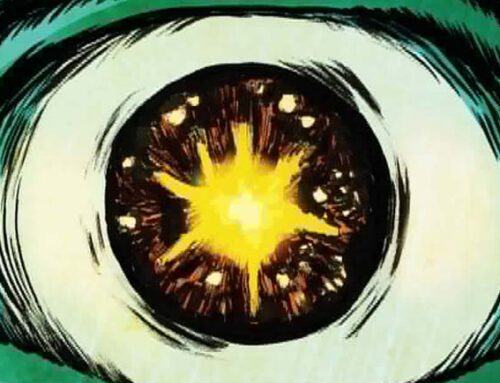
However, there are a few other films that are actually horror, and The Eye is one I have beef with. And I find it so significant in, again, in the type of message. Because this person gets corneas transplanted, the donor was a Mexican woman, and [the protagonist] starts to be haunted. Jessica Alba begins to have visions and of course that’s a classic trope related to eye transplants. But then she decides to go down to Mexico and find out what happened to her donor, because it’s so scary. She goes down to an absolute Mexican filter kind of setup, because it’s dusty, it’s yellow, it’s dirty, there are street dogs, and she ends up in this village.
Then eventually [Jessica Alba] finds the ghost, [and] she finds out the story of how the donor died. [The Mexican woman] was having visions and she foresaw a disaster at a factory, but she couldn’t save the people because they were telling her, “You’re [a] witch”, and they didn’t believe her. And eventually she kills herself because she has these visions and she’s haunted by the fact that she couldn’t save the people.
And of course, the point is that Jessica Alba goes down there and she saves the ghost. This person can be finally liberated and, you know, be redeemed by the fact that Jessica Alba got her corneas. And then when she is crossing the border back, disaster happens near the port of entry to the United States as this gas truck explodes. But she could see it beforehand because she has the supernatural vision eyes and she can save the people. Her corneas get damaged again, so she’s blind again eventually.
But of course, the point is that it’s this white woman (because she’s playing a white-codded woman), is the one who redeems the ghost, saves the people queueing there when the disaster happens, and all of it despite being contaminated by the brown body that she had in herself. You know, this donated tissue contaminated her. She was living a beautiful life being a blind genius violin player, and it was suddenly ruined by these corneas that entered her body. It’s a very physical sense of invasion, you know. And then eventually they’re taken away from her again because they get damaged, and she’s blind again. And now she’s like thriving even better as a genius violin player.
Actually, at the very end of the film, there’s the final reflections. And I cannot quote it to you, but I have it in the chapter. If you watch the movie, you’re going to hear her saying something along these lines. It’s again, the US hero who goes down and saves the day and goes back and now is such a better person despite (or because) she rid of the corneas. All the same time, she also saved the brown people down there.
I mean, it’s just so wild to me and it’s “funny” how this border crossing is always related to going down into [a] savage place, and you know, despite everything you’re still making it out alive, saving locals on the way out. It is a pattern that is so repetitive in a way.
When you were researching this book, was there anything that stood out to you that surprised you? Like, “Oh, I never realized that”? Or “Oh, I didn’t see that in this film until I watched it with more of that critical perspective”.
Let me think. I would say the Southwestern kind of settings, the weird Southwest. Maybe it’s not much of a sub-genre that I watched just for my own pleasure. And I thought it would be, of course, just like the classic Western which has its own things to be said about conquering and exceptionalism and so on and so forth.
But writing the book, I discovered weird Southwestern narratives that I didn’t quite delve into before. And I think there’s a lot of interesting things going on with these narratives that have actual traditional tropey monsters like werewolves or vampires, and they’re being reinterpreted through a Southwestern lens. So, I thought that that was definitely intriguing, and something that I had never really considered before.
What do you hope readers will learn from your book?
Well, I hope that they can see that borderlands horror is a thing. And I thought that I was personally missing [the] bigger picture. A bigger sense of what borderlands horror can be. And that is certainly something that I hope comes through my work. That it is more than a sub-genre, I would just call it a horror scape, you know. A horror mediascape that is fixed on the borderlands and the border itself and that it’s absolutely inextricable from historical matters and all of the geographical, cultural, and social issues that are connected to the borderlands. So that would be my main hope, you know, the main takeaway. And in general, I think there’s a lot of related texts that haven’t been examined before academically, so I hope that that they get some interest.
The US-Mexico Borderlands in Contemporary Horror is now available online, including Barnes & Noble and Amazon.